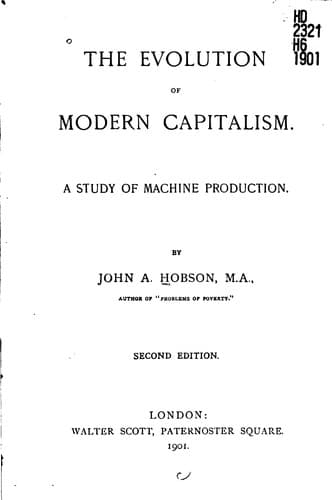
The Evolution of Modern Capitalism: A Study of Machine ProductionHobson, J. A. (John Atkinson)
History
The Evolution of Modern Capitalism: A Study of Machine Production
Hobson, J. A. (John Atkinson)
Capitalism; Industries -- History; Machinery in the workplace
§ 1. _The Modern Industrial Town as a Machine-product._
§ 2. _Growth of Town as compared with Rural Population in the Old
and New Worlds._
§ 3. _Limits imposed upon the Townward Movement by the Economic
Conditions of World-industry._
§ 4. _Effect of increasing Town-life upon Mortality._
§ 5. _The impaired quality of Physical Life in Towns._
§ 6. _The Intellectual Education of Town-life._
§ 7. _The Moral Education of Town-life._
§ 8. _Economic Forces making for Decentralisation._
§ 9. _Desirability of Public Control of Transport Services to
effect Decentralisation._
§ 10. _Long Hours and Insecurity of Work as Obstacles to Reforms._
§ 11. _The Principle of Internal Reform of Town-life._
§ 1. In the last few chapters we have examined some of the influences
of modern machine-production upon men and women in the capacity of
producers, in relation to character, duration, intensity, regularity
of employment, the remuneration of labour, and the economic relations
which subsist between workers and employers. It remains to give
special consideration to one factor in the environment of modern
industrial life, which is of paramount importance upon the public,
both in its working and living capacity.
The biggest, and in some respects the most characteristic of
machine-products is the modern industrial town. Steam-power is in a
most literal sense the maker of the modern town. When the motive-power
of industrial work was chiefly confined to the forces stored in man,
the economy obtained by collecting larger numbers of men to work in
close proximity to one another was comparatively small, and was
commonly outweighed by the difficulty of securing for them a
sufficient supply of food and other commodities, and by the greater
immobility of labour at a time when fixed local associations were a
strong binding force, and transport was slow and expensive. When the
earlier machinery drew its motive-power chiefly from water, the local
attachment and wide distribution of this power prevented the
concentration of industry from advancing very far. Only in proportion
as steam-power became the dominating agent did the economies of
factory-production drive the workers to crowd ever more densely in the
districts where coal and water for generating steam were most
accessible, and to throng together for the most economical use of
steam-power in industry.
Public-domain text, read in full here on John Shaqi.
Reviews
Reviews
No reviews yet
Be the first to share your thoughts on this work.
Elsewhere in the archive
Join the Discussion
Join the discussion
Sign in to leave a comment or review.
Sign InorCreate an account