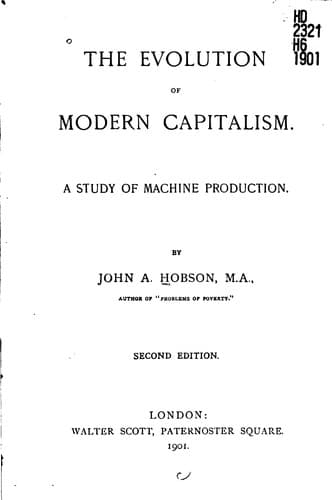
The Evolution of Modern Capitalism: A Study of Machine ProductionHobson, J. A. (John Atkinson)
History
The Evolution of Modern Capitalism: A Study of Machine Production
Hobson, J. A. (John Atkinson)
Capitalism; Industries -- History; Machinery in the workplace
(_d_) The wearisome monotony and lack of interest attending
highly specialised and sub-divided machine-industry, producing
physical lassitude.[281]
(_e_) Injuries arising from dust fumes, or other deleterious
matter, or from the handling of dangerous material or tools.
Much valuable work has been done of recent years by French, German,
and English physicians and statisticians, throwing light upon the
specific diseases appertaining to various industries, and giving some
measurement of their extent. But though certain specifically
industrial qualities have a considerable place in swelling the
mortality of towns, Dr. Arlidge is fully justified in his opinion that
in industrial centres more of the diseases are town-made than
trade-made. The statistics of infant mortality are conclusive upon
this point. In comparing the death-rates for town and country, the
difference is far wider for children below the industrial age than for
adults engaged in industrial work. Mr. Galton has calculated that in a
typical industrial town the number of children of artisan townsfolk
that grow up are little more than half as many as in the case of the
children of labouring people in a healthy country district.[282] The
figures quoted above from M. Levasseur relating to France point to a
similar conclusion. Many of the evils commonly classified as belonging
to specific industries, in particular the foul atmosphere, imperfect
sanitation, and overcrowding, which are found in many factories and
most city workshops, are rightly regarded as town-made rather than
trade-made, for they are the normal and often the necessary
accompaniments of a congested industrial population. In qualification
of this, having regard to the effects of machine-development, we must
remember that the worst hygienic conditions of town work are found in
those branches of industry which have lagged behind in industrial
evolution, while the best hygienic conditions are found in the most
highly-organised branches of textile industry. "Generally speaking,
the more elaborate and costly the machinery, the more excellent the
architecture. Thus in textile works machinery acquires its maximum of
importance, and by its dimensions necessitates commodious shops,
buildings of great size, and well-ordered arrangements to facilitate
the performance of the mutually dependent series of operations carried
on."[283]
Public-domain text, read in full here on John Shaqi.
Reviews
Reviews
No reviews yet
Be the first to share your thoughts on this work.
Elsewhere in the archive
Join the Discussion
Join the discussion
Sign in to leave a comment or review.
Sign InorCreate an account