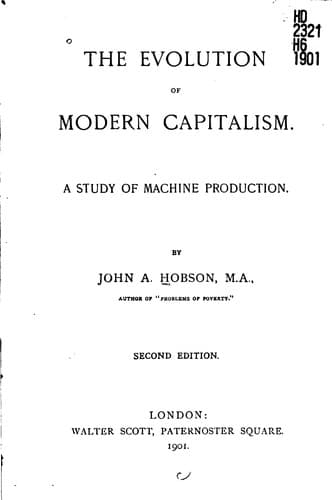
The Evolution of Modern Capitalism: A Study of Machine ProductionHobson, J. A. (John Atkinson)
History
The Evolution of Modern Capitalism: A Study of Machine Production
Hobson, J. A. (John Atkinson)
Capitalism; Industries -- History; Machinery in the workplace
Legal restrictions upon unhealthy and dangerous employments, shorter
working hours, adequate inspection, the stimulus given by such
measures to a more rapid application of highly-developed machinery,
may succeed in reducing considerably the physical evils directly
arising from town industries. But the town will still remain a more
unhealthy place to live in than the country, and as on the one hand
the fundamental and paramount importance of a healthy physical
environment receives fuller recognition, and on the other hand larger
leisure and opportunities of enjoyment and development make life more
valuable to the mass of the workers than it is at present, the
pressure of this problem of town life will grow apace.
§ 6. (_B_) That town life, as distinguished from town work, is
educative of certain intellectual and moral qualities, is evident.
Setting aside that picked intelligence which flows to the town to
compete successfully for intellectual employment, there can be no
question but that the townsman has a larger superficial knowledge of
the world and human nature. He is shrewd, alert, versatile, quicker,
and more resourceful than the countryman. In thought, speech, action,
this superiority shows itself. The townsman has a more developed
consciousness, his intelligence is constantly stimulated in a thousand
ways by larger and more varied society, and by a more diversified and
complex economic environment. While there is reason to believe that
town work is on the average less educative than country work, town
life more than turns the scale. The social intercourse of the club,
the trade society, the church, the home, the public-house, the
music-hall, the street, supply innumerable educative influences, to
say nothing of the ampler opportunities of consciously organised
intellectual education which are available in large towns. If,
however, we examine a little deeper the character of town education
and intelligence certain tolerably definite limitations show
themselves. School instruction, slightly more advanced than in the
country, is commonly utilised to sharpen industrial competition, and
to feed that sensational interest in sport and crime which absorbs the
attention of the masses in their non-working hours; it seldom forms
the foundation of an intellectual life in which knowledge and taste
are reckoned in themselves desirable. The power to read and write is
employed by the great majority of all classes in ways which evoke a
minimum of thought and wholesome feeling. Social, political, and
religious prejudices are made to do the work which should be done by
careful thought and scientific investigation.
Public-domain text, read in full here on John Shaqi.
Reviews
Reviews
No reviews yet
Be the first to share your thoughts on this work.
Elsewhere in the archive
Join the Discussion
Join the discussion
Sign in to leave a comment or review.
Sign InorCreate an account