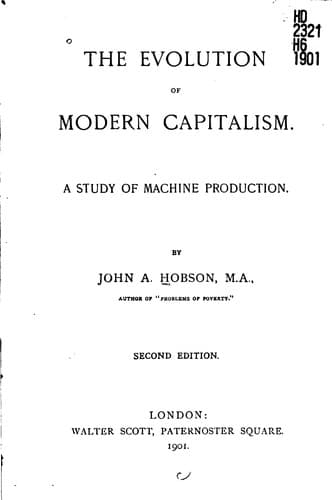
The Evolution of Modern Capitalism: A Study of Machine ProductionHobson, J. A. (John Atkinson)
History
The Evolution of Modern Capitalism: A Study of Machine Production
Hobson, J. A. (John Atkinson)
Capitalism; Industries -- History; Machinery in the workplace
to do, or of doing it if they could get it.
If the town were a social organism formed by men desirous of living
together for mutual support, comfort, and enjoyment in their lives, it
might reasonably be expected that a wholesome public feeling would be
so strongly operative as to outweigh the increased opportunities of
crime. But, as we have seen, the modern town is a result of the desire
to produce and distribute most economically the largest aggregate of
material goods: economy of work, not convenience of life, is the
object. Now, the economy of factory co-operation is only social to a
very limited extent; anti-social feelings are touched and stimulated
at every point by the competition of workers with one another, the
antagonism between employers and employed, between sellers and buyers,
factory and factory, shop and shop.
Perhaps the most potent influence in breaking the strength of the
_morale_ of the town worker is the precarious and disorderly
character of town work. That element of monotonous order, which we
found excessive in the education afforded by the individual machine to
the machine-tender, is balanced by a corresponding defect in
machine-industry taken as a whole. Town work, as we have seen, is more
irregular than country work, and this irregularity has a most
pernicious effect upon the character of the worker. Professor Foxwell
has thus strikingly expressed the moral influences of this economic
factor: "When employment is precarious, thrift and self-reliance are
discouraged. The savings of years may be swallowed up in a few months.
A fatalistic spirit is developed. Where all is uncertain and there is
not much to lose, reckless overpopulation is certain to be set at.
These effects are not confined to the poorer classes. The business
world is equally demoralised by industrial speculation, careful
prevision cannot reckon upon receiving its due return, and speculation
of the purest gambling type is thereby encouraged. But the working
class suffers most."[286]
Public-domain text, read in full here on John Shaqi.
Reviews
Reviews
No reviews yet
Be the first to share your thoughts on this work.
Elsewhere in the archive
Join the Discussion
Join the discussion
Sign in to leave a comment or review.
Sign InorCreate an account