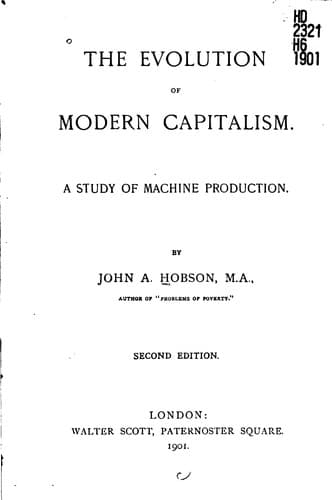
The Evolution of Modern Capitalism: A Study of Machine ProductionHobson, J. A. (John Atkinson)
History
The Evolution of Modern Capitalism: A Study of Machine Production
Hobson, J. A. (John Atkinson)
Capitalism; Industries -- History; Machinery in the workplace
Scattered and unrelated fragments of half-baked information form a
stock of "knowledge" with which the townsman's glib tongue enables him
to present a showy intellectual shop-front. Business smartness pays
better in the town, and the low intellectual qualities which are
contained in it are educated by town life. The knowledge of human
nature thus evoked is in no sense science, it is a mere rule-of-thumb
affair, a thin mechanical empiricism. The capable business man who is
said to understand the "world" and his fellow-men, has commonly no
knowledge of human nature in the larger sense, but merely knows from
observation how the average man of a certain limited class is likely
to act within a narrow prescribed sphere of self-seeking. Town life,
then, strongly favours the education of certain shallow forms of
intelligence. In actual attainment the townsman is somewhat more
advanced than the countryman. But the deterioration of physique which
accompanies this gain causes a weakening of mental fibre: the
potentiality of intellectual development and work which the countryman
brings with him on his entry to town life is thwarted and depressed by
the progressive physical enfeeblement. Most of the best and strongest
intellectual work done in the towns is done by immigrants, not by
town-bred folk.
§ 7. (_C_) This intellectual weakness of town life is best expressed
in terms which show the intimate relation between intelligence and
morals. A lack of "grit," pertinacity of purpose, endurance,
"character," marks the townsman of the second generation as compared
with the countryman. As the intellectual powers of the townsman,
though quantitatively impaired, are more highly developed than those
of the countryman, so it is with his "morals." In positive
attainments of conscience, virtue, and vice, the townsman shows
considerable advance. This point is commonly misunderstood. The annals
of crime afford irrefutable evidence of the greater criminality of the
towns. London, containing less than one-fifth of the population of
England and Wales, is responsible for more than one-third of the
annual number of indictable crimes.[284] In France the criminality of
the urban population is just double that of the rural population.[285]
In 1884-86, out of each 100,000 city population sixteen were charged
with crimes; out of each 100,000 rural population only eight. It is
indeed commonly recognised in criminology that, other things being
equal, crime varies with the density of population. There is no
difficulty in understanding why this should be so. The pressure of
population and the concentration of property afford to the
evil-disposed individual an increased number of temptations to invade
the person or property of others; for many sorts of crime the
conditions of town life afford greater security to the criminal;
social and industrial causes create a large degenerate class not
easily amenable to social control, incapable of getting regular work
Public-domain text, read in full here on John Shaqi.
Reviews
Reviews
No reviews yet
Be the first to share your thoughts on this work.
Elsewhere in the archive
Join the Discussion
Join the discussion
Sign in to leave a comment or review.
Sign InorCreate an account