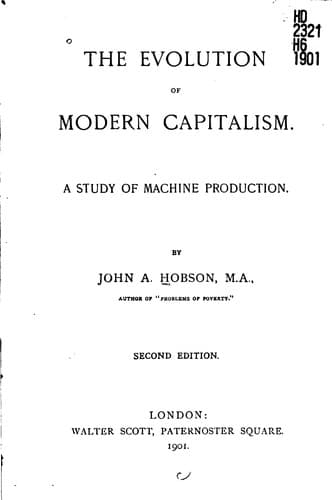
The Evolution of Modern Capitalism: A Study of Machine ProductionHobson, J. A. (John Atkinson)
History
The Evolution of Modern Capitalism: A Study of Machine Production
Hobson, J. A. (John Atkinson)
Capitalism; Industries -- History; Machinery in the workplace
A full inductive treatment would perhaps require this inquiry to be
prefaced by a full history of the inventions which in the several
industries mark the rise of the factory system and the adoption of
capitalist methods. This, however, is beyond the scope of the present
work, nor does it strictly belong to our scientific purpose, which is
not to write the narrative of the industrial revolution, but to bring
such analysis to bear upon the records of industrial changes as shall
enable us to clearly discern the laws of those changes.
The central position occupied by machinery as the chief material
factor in the modern evolution of industry requires that a distinct
answer should be given to the question, What is machinery?
In distinguishing a machine from a mere tool or handicraft implement
it is desirable to pay special attention to two points, complexity of
structure and the activity of man in relation to the machine. Modern
machinery in its most developed shape consists, as Karl Marx points
out, of three parts, which, though mechanically connected, are
essentially distinct, the motor mechanism, the transmitting mechanism,
and the tool or working machine.
"The motor mechanism is that which puts the whole in motion. It either
generates its own motive power, like the steam-engine, the caloric
engine, the electro-magnetic machine, etc., or it receives its impulse
from some already existing natural force, like the water-wheel from a
head of water, the windmill from wind, etc. The transmitting
mechanism, composed of fly-wheels, shafting, toothed wheels, pullies,
straps, ropes, bands, pinions, and gearing of the most varied kind,
regulates the motion, changes its form where necessary, as, for
instance, from linear to circular, and divides and distributes it
among the working machines. These two first parts of the whole
mechanism are there solely for putting the working machines in motion,
by means of which motion the subject of labour is seized upon and
modified as desired."[58]
Public-domain text, read in full here on John Shaqi.
Reviews
Reviews
No reviews yet
Be the first to share your thoughts on this work.
Join the Discussion
Join the discussion
Sign in to leave a comment or review.
Sign InorCreate an account