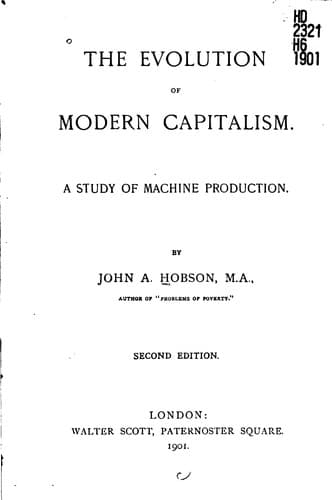
The Evolution of Modern Capitalism: A Study of Machine ProductionHobson, J. A. (John Atkinson)
History
The Evolution of Modern Capitalism: A Study of Machine Production
Hobson, J. A. (John Atkinson)
Capitalism; Industries -- History; Machinery in the workplace
§ 10. The new industrial forces first applied to the cotton spinning
of South Lancashire, and rapidly forcing their way into other branches
of the textile manufactures, then more gradually transforming the
industrial methods of the machinery, hardware, and other staple
English manufactures, passed into the Western Continent of Europe and
America, destroying the old domestic industry and establishing in
every civilised country the reign of steam-driven machinery. The
factors determining the order and pace of the new movement in the
several countries are numerous and complex. In considering the order
of machine-development, it must be remembered that the different
nations did not start from an equal footing at the opening of the age
of great inventions. By the beginning of the eighteenth century
England had established a certain supremacy in commerce. The growth of
her colonial possessions since the Revolution and the drastic and
successful character of her maritime policy had enabled her to
outstrip Holland. In 1729 by far the greater part of the Swedish iron
exported from Gothenburg went to England for shipbuilding
purposes.[83] At the close of the seventeenth century Gregory King
placed England, Holland, and France at the head of the industrial
nations with regard to the productivity of their labour.[84] Italy
and Germany were little behind in the exercise of manufacturing arts,
though the naval superiority and foreign possessions of the
above-named nations gave them the commercial superiority. By 1760
England had strengthened her position as regards foreign commerce, and
her woollen industry was the largest and most highly-developed
industry in the world. But so far as the arts of manufacture
themselves were concerned there was no such superiority in England as
to justify the expectation of the position she held at the opening of
the nineteenth century. In many branches of the textile arts,
especially in silk spinning and in dyeing, in pottery, printing, and
other manufactures, more inventive genius and more skill were shown on
the Continent, and there seemed _à priori_ no reason why England
should outstrip so signally her competitors.
The chief factors in determining the order of the development of
modern industrial methods in the several countries may be classified
as natural, political, economic.
Public-domain text, read in full here on John Shaqi.
Reviews
Reviews
No reviews yet
Be the first to share your thoughts on this work.
Elsewhere in the archive
Join the Discussion
Join the discussion
Sign in to leave a comment or review.
Sign InorCreate an account