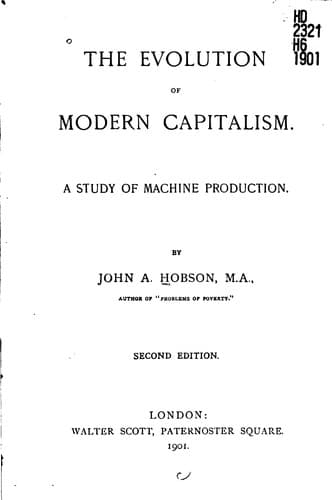
The Evolution of Modern Capitalism: A Study of Machine ProductionHobson, J. A. (John Atkinson)
History
The Evolution of Modern Capitalism: A Study of Machine Production
Hobson, J. A. (John Atkinson)
Capitalism; Industries -- History; Machinery in the workplace
NATURAL. (1) _The structure and position of the several
countries._--The insular character of Great Britain, her natural
facilities for procuring raw materials of manufacture and supplies of
foreign food to enable her population to specialise in manufacture,
the number and variety of easily accessible markets for her
manufactures, gave her an immense advantage. Add to this a temperate
climate, excellent internal communication by river (or canal), and an
absence of mountain barriers between the several districts. These
advantages were of greater relative importance before steam transport,
but they played a large part in facilitating the establishment of
effective steam transport in England. Extent of sea-board and good
harbourage have in no small measure directed the course of modern
industry, giving to England, Holland, France, Italy an advantage which
the levelling tendency of modern machinery has not yet been able to
counteract. The slow progress of Germany until recent years, and the
still slow progress of Russia, is attributable more to these physical
barriers of free communication, internal and external, than to any
other single cause that can be adduced. Inherent resources of the
soil, quality of land for agriculture, the proximity of large supplies
of coal and iron and other requisites of the production of machinery
and power rank as important determinants of progress. The machine
development of France in particular has been retarded by the slow
discovery of her natural areas of manufacture, the districts where
coal and iron lie near to one another in easily accessible supply. The
same remark applies to Germany and to the United States. At the close
of last century, when the iron trade of England was rapidly advancing,
the iron trade of France were quite insignificant, and during the
earlier years of the nineteenth century the progress was extremely
slight.[85]
Public-domain text, read in full here on John Shaqi.
Reviews
Reviews
No reviews yet
Be the first to share your thoughts on this work.
Elsewhere in the archive
Join the Discussion
Join the discussion
Sign in to leave a comment or review.
Sign InorCreate an account