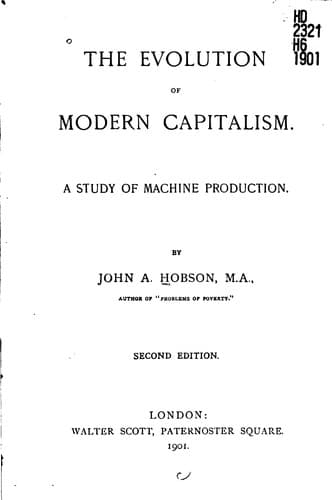
The Evolution of Modern Capitalism: A Study of Machine ProductionHobson, J. A. (John Atkinson)
History
The Evolution of Modern Capitalism: A Study of Machine Production
Hobson, J. A. (John Atkinson)
Capitalism; Industries -- History; Machinery in the workplace
But the most important factor determining the priority of England was
the political condition of continental Europe at the very period when
the new machinery and motor-power were beginning to establish
confidence in the new industrial order. When Crompton's mule,
Cartwright's power-loom, Watt's engines were transforming the industry
of England, her continental rivals had all their energies absorbed in
wars and political revolutions. The United States and Sweden were the
only commercial nations of any significance who, being neutral,
obtained a large direct gain from the European strife. Yet England, in
spite of the immense drain of blood and money she sustained, under the
momentum of the new motor-power far outstripped the rivalry of such
states. Though she had to pay a heavy price for her immunity from
invasion, she thereby secured an immense start in the race of modern
machine-production. Until 1820 she had the game in her own hands. In
European trade she had a practical monopoly of the rapidly advancing
cotton industry. It was this monopoly which, ruthlessly applied to
maintain prices at a highly remunerative rate, and to keep down wages
to starvation point, built up, in an age of supreme and almost
universal misery for the masses, the rapid and colossal fortunes of
the cotton kings. Not until peace was established did the textile and
other factories begin to take shape upon the Continent, and many
years elapsed before they were able to compete effectively with
England. Switzerland was the first continental country to actively
adopt the new methods. The large supply of water-power stood her in
good stead, and the people took more willingly to the factory system
than in other countries.[87] France was slower in her development, in
spite of the strong protective system by which she strove, though not
very successfully, to exclude English cotton goods. The fall of
English prices and profits in the cotton trade between 1820 and 1830
marks clearly the breakdown of the English monopoly before the cheap
labour of Alsace and the cheap raw material of the United States, now
organised in the factory system with the new machinery.[88] In this,
the most advanced trade, the world-competition which now is operative
in a thousand different industries, measuring and levelling economic
advantages, first clearly shows itself, and in 1836 Ure finds the
continental nations and America competing successfully with England in
markets which had hitherto been entirely her own.
(_c_) ECONOMIC CONDITIONS.--The transformation of English agriculture,
the growth of large farms, drove great numbers of English peasants
into the towns, and furnished a large supply of cheap labour for the
new machinery.
Public-domain text, read in full here on John Shaqi.
Reviews
Reviews
No reviews yet
Be the first to share your thoughts on this work.
Elsewhere in the archive
Join the Discussion
Join the discussion
Sign in to leave a comment or review.
Sign InorCreate an account