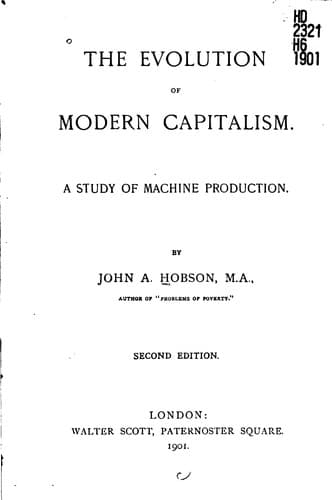
The Evolution of Modern Capitalism: A Study of Machine ProductionHobson, J. A. (John Atkinson)
History
The Evolution of Modern Capitalism: A Study of Machine Production
Hobson, J. A. (John Atkinson)
Capitalism; Industries -- History; Machinery in the workplace
(2) _Race and National Character._--Closely related to climate and
soil, these qualities of race are a powerful directing influence in
industry. Muscular strength and endurance, yielding in a temperate
climate an even continuity of vigorous effort; keen zest of material
comfort stimulating invention and enterprise; acquisitiveness, and the
love of external display; the moral capacities of industry, truth,
orderly co-operation; all these are leading factors determining the
ability and inclination of the several nations to adopt new industrial
methods. Moral qualities in English workmanship have indisputably
played a large part in securing her supremacy. "A British trade-mark
was accepted as a guarantee of excellence, while the products of other
countries were viewed with a suspicion justified by experience of
their comparative inferiority."[86] The more highly civilised nations
have thus gained by this civilisation, and have widened the distance
which separates them from the less civilised. England, France,
Germany, Holland, and the United States are in wealth and in
industrial methods far more widely removed from Spain and Russia than
was the case a hundred years ago.
(_b_) POLITICAL.--Statecraft has played an important part in
determining the order and pace of industrial progress. The possession
of numerous colonies and other political attachments in different
parts of the world, comprising a large variety of material resources,
gave to England, and in a less measure to France, Holland, Spain, a
great advantage. The tyrannical use these nations made of their
colonies for the purpose of building up home manufactures enabled
them to specialise more widely and safely in those industries to which
the new methods of production were first applied. Even after the North
American colonies broke loose, the policy of repression England had
applied to their budding manufactures enabled her to retain to a large
extent the markets thus created for her manufactured goods.
The large annexations England made during the eighteenth and early
nineteenth centuries gave her a monopoly of many of the finest markets
for the purchase of raw materials and for the sale of manufactured
goods. The large demand thus established for her textile and metal
wares served not only to stimulate fresh inventions, but enabled her
to utilise many improvements which could only be profitably applied in
the case of large industries with secure and expanding markets.
Public-domain text, read in full here on John Shaqi.
Reviews
Reviews
No reviews yet
Be the first to share your thoughts on this work.
Elsewhere in the archive
Join the Discussion
Join the discussion
Sign in to leave a comment or review.
Sign InorCreate an account