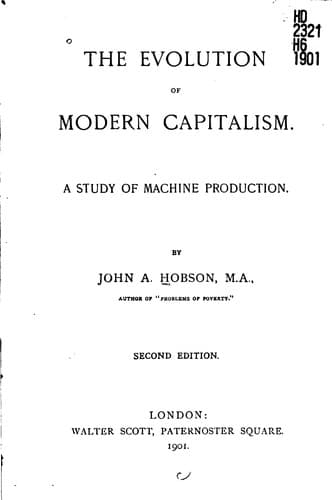
The Evolution of Modern Capitalism: A Study of Machine ProductionHobson, J. A. (John Atkinson)
History
The Evolution of Modern Capitalism: A Study of Machine Production
Hobson, J. A. (John Atkinson)
Capitalism; Industries -- History; Machinery in the workplace
In considering the effect of modern machine-production upon the
Business, the most obvious external change is a great increase in
size. The typical unit of production is no longer a single family or a
small group of persons working with a few cheap simple tools upon
small quantities of material, but a compact and closely organised mass
of labour composed of hundreds or thousands of individuals,
co-operating with large quantities of expensive and intricate
machinery, through which passes a continuous and mighty volume of raw
material on its journey to the hands of the consuming public.
The expansion in mass of labour and capital composing the industrial
unit does not, however, proceed at the same pace in the different
industries.
The largest growths are found in two classes of industry. First, those
which close dependence on monopoly of land, or other privilege
conferred by state or municipal government, has placed outside
competition. The size here is determined by that amount of capital
required to achieve the most profitable equation of supply and demand
prices under terms of monopoly.[99] In this class are placed such
large businesses as railways, gas, or water companies. Second, those
industries where the net advantages of large-scale production over
small scale in competitive industry are greatest. Generally speaking,
those industries where the most expensive machinery is employed come
under this head, or where, as in banking and financial business, a
large capital is managed more economically, and enjoys a monopoly of
certain profitable kinds of work.
In retail trade, where neither of these forces is so powerfully
operative, the increase in mass of capital and labour is not so great,
though here too the economies of large-scale production are giving
more and more prominence to the Universal Provider, and a large number
of local shops are falling into the hands of companies. Large
syndicates of capital at Smithfield are owning butchers' shops in most
large towns, the drapery, jewellery, shoe trade are more and more
passing into the hands of large companies, while an increased
proportion of tobacconists, publicans, grocers, and other retailers
are practically but agents of large capitalist firms. In such branches
of agriculture as have lent themselves most effectively to new
machinery the same movement is visible in the prevalence of large
farming. This is seen everywhere where land is placed on the same
property footing as other forms of capital. Though small farms are for
some purposes still capable of yielding a large net as well as gross
product, it is for the most part the legal, customary, and
sentimental restrictions on free transfer of land that impede the
tendency towards large farming.
Public-domain text, read in full here on John Shaqi.
Reviews
Reviews
No reviews yet
Be the first to share your thoughts on this work.
Elsewhere in the archive
Join the Discussion
Join the discussion
Sign in to leave a comment or review.
Sign InorCreate an account