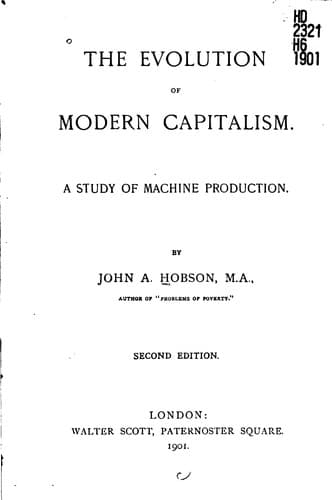
The Evolution of Modern Capitalism: A Study of Machine ProductionHobson, J. A. (John Atkinson)
History
The Evolution of Modern Capitalism: A Study of Machine Production
Hobson, J. A. (John Atkinson)
Capitalism; Industries -- History; Machinery in the workplace
Selling price 16 0 10 11 7 6 2 6 1 2-1/2 0 10-1/2
Cost of Cotton
(18 oz.) 2 0 2 0 3 4 1 6 0 7-3/4 0 7-1/8
----- ----- ---- ---- -------- ---------
Labour & Capital 14 0 8 11 4 2 1 0 0 6-3/4 0 3-3/8
[89] Porter, _Progress of the Nation_, p. 13. Eighteenth century
figures are, however, not trustworthy. The first census was in 1801.
[90] Ure, _Philosophy of Manufactures_, p. 531.
[91] Schulze-Gaevernitz, _Der Grossbetrieb_, p. 34.
[92] In 1882 42 per cent. of the German textile industry was still
conducted in the home or domestic workshop, while only 38 per cent.
was carried on in factories employing more than 50 persons. More
weavers were still engaged with hand-looms than with power-looms, and
the latter was so little developed that the hand-loom could still hold
its own in many articles. Knitting, lace-making, and other minor
textile industries are still in the main home industries.--(_Social
Peace_, p. 113.) "While in England in 1885 each spinning or weaving
mill had an average of 191 operatives, each spinning mill in Germany
in 1882 employed an average of 10 persons only."--(Brentano, _Hours,
Wages, and Production_, p. 64.)
[93] Ure, _Philosophy of Manufactures_, p. 515.
[94] Toynbee, _Industrial Revolution_, p. 79.
[95] The highly elaborate American machine industry of watch-making is
a striking example of this influence of high wages. Cf.
Schulze-Gaevernitz, _Social Peace_, p. 125.
[96] Schoenhof, _Economy of High Wages_, p. 279.
[97] _Ibid._, pp. 225, 226.
[98] Schulze-Gaevernitz, p. 66 (note). This six and eight-loom weaving
is, however, at a lower speed.
CHAPTER IV.
THE STRUCTURE OF MODERN INDUSTRY.
§ 1. _Growing Size of the Business-Unit._
§ 2. _Relative Increase of Capital and Labour in the Business._
§ 3. _Increased Complexity and Integration of Business
Structure._
§ 4. _Structure and Size of the Market for different
Commodities._
§ 5. _Machinery a direct Agent in expanding Market Areas._
§ 6. _Expanded Time-area of the Market._
§ 7. _Interdependency of Markets._
§ 8. _Sympathetic and Antagonistic Relations between Trades._
§ 9. _National and Local Specialisation in Industry._
§ 10. _Influences determining Localisation of Industry under
World-Competition._
§ 11. _Impossibility of Final Settlement of Industry._
§ 12. _Specialisation in Districts and Towns._
§ 13. _Specialisation within the Town._
§ 1. Turning once more to the unit of industry, the Business, and
thence to the Trade and the Market, or area of competition, it is
necessary to examine the structural and functional changes brought
about by the action of the new industrial forces.
Public-domain text, read in full here on John Shaqi.
Reviews
Reviews
No reviews yet
Be the first to share your thoughts on this work.
Elsewhere in the archive
Join the Discussion
Join the discussion
Sign in to leave a comment or review.
Sign InorCreate an account