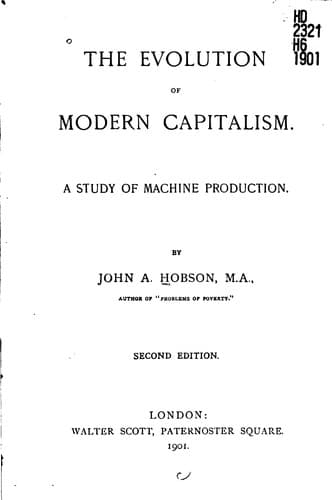
The Evolution of Modern Capitalism: A Study of Machine ProductionHobson, J. A. (John Atkinson)
History
The Evolution of Modern Capitalism: A Study of Machine Production
Hobson, J. A. (John Atkinson)
Capitalism; Industries -- History; Machinery in the workplace
§ 3. In addition to increased size we find increased and
ever-increasing complexity of structure in the business-unit. This has
proceeded in two directions, horizontally and laterally--that is to
say, by subdivision and accession of processes on the one hand, and by
an increased variety of products, and therefore of processes, upon the
other hand. The constantly growing specialisation of fixed capital and
of labour in our factories and workshops is a commonplace. Adam
Smith's famous pin manufactory, with its ten separate processes, has
been left far behind. In a modern shoe factory in the United States
there are sixty-four distinct processes. Grain, in the elaborate
machinery of a steam flour mill, passes through a score of different
stages, cleaning, winnowing, grinding, etc. The American machine-made
watch is the product of 370 separate processes. The organisation of a
modern textile factory provides a dozen different processes
contributing to the spinning or weaving of cotton or silk. New
processes of cleaning, finishing, and ornamenting are continually
being added. The subsidiary process of packing, the manufacture of
packing cases, the printing of labels, etc., are taken on in many
factories.[108] Many branches of production which were formerly
carried on in separate places and as separate business-units are
grouped together under the factory roof, or if still separated
locally, and executed by separate machinery and power, are related as
forming part of the same business, and are under the same management.
So in the woollen manufactures the preliminary processes of sorting
and cleansing, carding or combing, as well as the main processes of
spinning and weaving, fulling, dyeing, and finishing, each of which
was once committed to a separate and independent group of workers, are
now frequently found going on simultaneously in a single factory.[109]
Thus a number of small simple business-units representing the various
stages in the production of a commodity, come to group themselves into
a large complex unit.
Public-domain text, read in full here on John Shaqi.
Reviews
Reviews
No reviews yet
Be the first to share your thoughts on this work.
Elsewhere in the archive
Join the Discussion
Join the discussion
Sign in to leave a comment or review.
Sign InorCreate an account