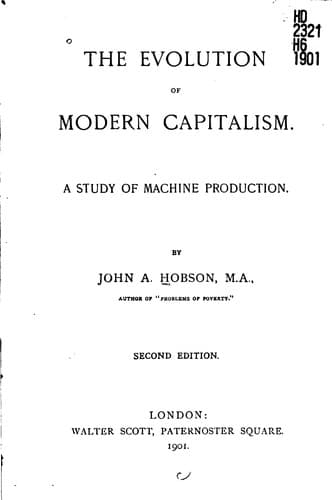
The Evolution of Modern Capitalism: A Study of Machine ProductionHobson, J. A. (John Atkinson)
History
The Evolution of Modern Capitalism: A Study of Machine Production
Hobson, J. A. (John Atkinson)
Capitalism; Industries -- History; Machinery in the workplace
This complexity is further increased by constant demand for variety in
size, quality, and character of goods to meet the growing variety of
demand in a market of increasing area. Special classes of goods must
be manufactured for Australia, for Egypt, for Burmah. Less civilised
customers, including such countries as China and Persia, insist upon
their imported goods being made up and packed in some familiar form
long after the use or convenience of this form has passed away. The
exigencies of close competition require constant experiment in new
lines of goods to benefit the fancy of a newly-opened market, or to
get away the trade of some competitor. Moreover, the increasingly
important part which is played by advertising in the trades where
competition is keenest is followed by a very singular result, which
seems at first sight to contravene the growing specialism or
differentiation of function that marks modern trade. Finding that
goods advertise one another, manufacturers are frequently induced to
add new departments to their business, expanding the scope and variety
of their productions. In retail trade this tendency is widely
operative. The modern grocer sells tinned meats, cakes, wine,
tea-pots, and Christmas cards, the draper sells every sort of
ornamental ware, the stationer, the oil shop, the china shop set out
an increasing and miscellaneous number of differing wares, moving
towards the position of a general dealer. The Stores and the Universal
Providers represent the culmination of this movement in the retail
business, returning to an enlarged and more complex form of the
primitive little "general shop" of the village. But this same economy
is strong enough in certain classes of manufacture to overpower the
advantages of an expansion of business in the older form. Up to a
certain point the economies of production upon a large scale will make
it advantageous to a manufacturer to employ all the capital at his
command in producing increased quantities of the same class of goods.
But after the market for these goods is fairly supplied it may pay
better to appeal to a variety of wants by new species of goods of the
same generic character, than by attempting to force new markets, or to
effect an increased sale in the old markets at such reduced prices as
the increased scale of production may permit. The business of Messrs.
Huntley & Palmer is a striking example of this enterprise, issuing in
a large variety of products and of processes which, though generically
related, cover a widening range of food luxuries. The new products
which are taken on will of course not only reap the advantage of being
effectively advertised by the earlier products, but consisting
largely of new adaptations of the same kind of raw material, the
economies of purchase and transport will be almost as great as attend
an increased production of the same goods, while much of the machinery
of management, and even of manufacture, can be utilised for the new
processes.
Public-domain text, read in full here on John Shaqi.
Reviews
Reviews
No reviews yet
Be the first to share your thoughts on this work.
Elsewhere in the archive
Join the Discussion
Join the discussion
Sign in to leave a comment or review.
Sign InorCreate an account