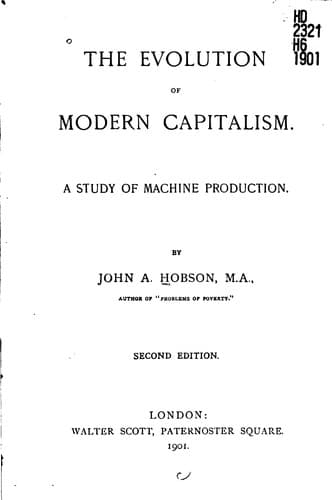
The Evolution of Modern Capitalism: A Study of Machine ProductionHobson, J. A. (John Atkinson)
History
The Evolution of Modern Capitalism: A Study of Machine Production
Hobson, J. A. (John Atkinson)
Capitalism; Industries -- History; Machinery in the workplace
This tendency not merely to multiply processes in the
manufacture of a single commodity, but to increase the variety of
commodities turned out by analogous processes in a single business, is
also operative in certain textile and metal industries, where an
increasing proportion of the expensive machinery and skilled labour is
engaged, not in narrowly specific processes of manufacture, but in
generating power and in transmitting it for a number of later uses to
be governed by specific machinery. There is in many factories an
increasing facility to take on new processes, and to transfer a large
portion of the plant from the manufacture of one class of goods to
another class.
"Most of the operatives in a watch factory would find machines very
similar to those with which they were familiar if they strayed into a
gun-making factory or sewing-machine factory, or a factory for making
textile machinery. A watch factory, with those who worked in it, could
be converted without any overwhelming loss into a sewing-machine
factory."[110] Thus in the evolution of the modern business we see not
only a number of processes in the production of a commodity, each of
which constituted a separate business-unit in the earlier division of
labour, growing together into a large complex whole, but a growing
together of analogous processes in the production of different
commodities, a lateral aggregation of processes. So we recognise that
the growing complexity of the business-unit, whether we regard it from
the point of view of capital or of labour, arises in large measure
from an increased integration of productive processes. The
business-unit is larger, more heterogeneous, and more highly
integrated.
Public-domain text, read in full here on John Shaqi.
Reviews
Reviews
No reviews yet
Be the first to share your thoughts on this work.
Elsewhere in the archive
Join the Discussion
Join the discussion
Sign in to leave a comment or review.
Sign InorCreate an account