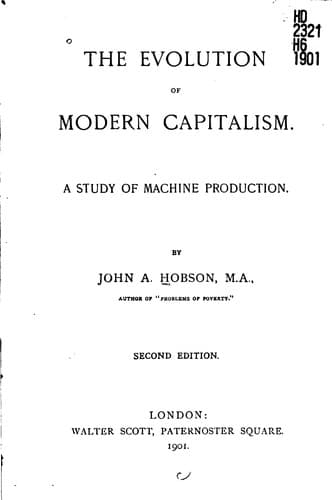
The Evolution of Modern Capitalism: A Study of Machine ProductionHobson, J. A. (John Atkinson)
History
The Evolution of Modern Capitalism: A Study of Machine Production
Hobson, J. A. (John Atkinson)
Capitalism; Industries -- History; Machinery in the workplace
(_c_) _Durability._--Durable objects and objects which can easily be
brought within reach of modern means of rapid transport have a wide
market. Perishable goods, as, for example, many fruits and vegetables,
have for these reasons a narrow market.
§ 5. Modern machinery has in almost all cases raised the size of the
market. The space-area of competition has been immensely widened,
especially for the more durable classes of goods. It is machinery of
transport--the transport of goods and news--that is chiefly
responsible for this expansion. Cheaper, quicker, safer, and more
calculable journeys have shrunk space for competing purposes. Improved
means of rapid and reliable information about methods of production,
markets, changes in price and trade have practically annihilated the
element of distance.
Machinery of manufacture as well as of transport has a levelling
tendency which makes directly for expansion of the area of
competition. As the spread of knowledge places each part of the
industrial world more closely _en rapport_ with the rest, the newest
and best methods of manufacture are more rapidly and effectively
adopted. Thus in all production where less and less depends on the
skill of the workers, and more and more upon the character of the
machinery, every change which gives more prominence to the latter
tends to equalise the cost of production in different countries, and
thus to facilitate effective competition.
§ 6. Modern methods of production have also brought about a great
expansion in the time-area of the market. Competition covers a wider
range of time as well as of space. Production is no longer directed by
the quantity and quality of present needs alone, but is more and more
dependent upon calculation of future consumption. A larger proportion
of the brain power of the business man is devoted to forecasting
future conditions of the market, and a larger proportion of the
mechanical and human labour to providing future goods to meet
calculated demands. This expansion of the time-market, or growth of
speculative production, is partly cause, partly effect of the improved
mechanical appliances in manufacture and in transport. The
multiplication of productive power under the new machinery has in many
branches of industry far outstripped the requirements of present known
consumption at remunerative prices, while increased knowledge of the
widening market has given a basis of calculation which leads
manufacturers to utilise their spare productive power in providing
against future wants. So long as industry was limited by the labour of
the human body, assisted but slightly by natural forces and working
with simple tools, the output of productive energy could seldom
outstrip the present demand for consumable goods.
Public-domain text, read in full here on John Shaqi.
Reviews
Reviews
No reviews yet
Be the first to share your thoughts on this work.
Elsewhere in the archive
Join the Discussion
Join the discussion
Sign in to leave a comment or review.
Sign InorCreate an account