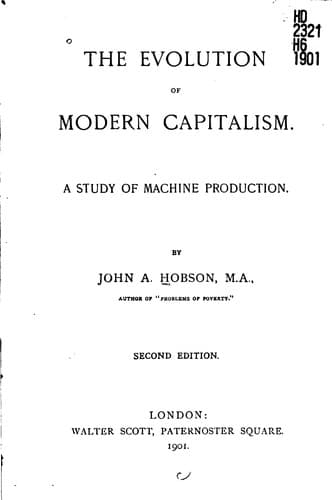
The Evolution of Modern Capitalism: A Study of Machine ProductionHobson, J. A. (John Atkinson)
History
The Evolution of Modern Capitalism: A Study of Machine Production
Hobson, J. A. (John Atkinson)
Capitalism; Industries -- History; Machinery in the workplace
But machinery has changed all this. Modern industrial nations are able
to produce consumables far faster than those who have the power to
consume them are willing to exercise it. Hence there is an
ever-increasing margin of productive power redundant so far as the
production of present consumptive goods is concerned. This excess of
productive power is saved. It can only be saved by being stored up in
some material forms which are required not for direct consumption but
for assisting to increase the rate at which consumables may be
produced in the future. In order to make a place for these new forms
of saving it is necessary to interpose a constantly increasing number
of mechanical processes between the earliest extractive process which
removes the raw material from the earth and the final or retailing
process which places it in the consumer's hands. New machinery, more
elaborate and costly, is applied; special workshops, with machines to
make this machinery--other machinery to make these machines; there is
an expansion of the mechanism of credit, the system of agents and
representatives is expanded, new modes of advertising are adopted.
Thus an ever-widening field of investment is provided for the spare
energy of machine-production. The change is commonly described by
saying that production is more "roundabout."[112] A larger number of
steps are inserted in the ladder of production. This increased
complexity in the mechanism of production is not, however, the central
point of importance. We must realise that the change is one which is
essentially an increase in the "speculative" character of commerce.
The "roundabout" method of production signifies a continual increase
in the proportion of productive forces devoted to making "future
goods" as Now future goods, plant, machinery, raw material of
commodities, are essentially "contingent goods": their worth or waste
depends largely upon conditions yet unborn: their social utility and
the value based upon it depend entirely upon the future powers and
desires of those unknown persons who are expected to purchase and
consume the commodities which shall come into existence as results of
the existence and activity of these future goods.
The actual time which elapses between the extractive stage and the
final retail stage of a commodity may not be greater and is in many
cases far less under the new methods of industry. The raw cotton of
South Carolina gets on the wearer's back more quickly than it did a
century and a half ago. But when we add in the time-elements involved
in the provision of the various forms of intricate plant and machinery
whose utility entirely consists in forwarding these cotton goods, and
whose existence in the industrial mechanism depends upon them, we
shall perceive that the "roundabout" method signifies a great
extension of the speculative or time-element in the market.[113]
Public-domain text, read in full here on John Shaqi.
Reviews
Reviews
No reviews yet
Be the first to share your thoughts on this work.
Elsewhere in the archive
Join the Discussion
Join the discussion
Sign in to leave a comment or review.
Sign InorCreate an account