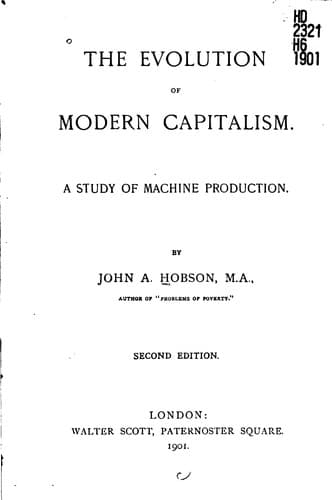
The Evolution of Modern Capitalism: A Study of Machine ProductionHobson, J. A. (John Atkinson)
History
The Evolution of Modern Capitalism: A Study of Machine Production
Hobson, J. A. (John Atkinson)
Capitalism; Industries -- History; Machinery in the workplace
§ 12. The same laws and the same limitations which are operative in
determining the character and degree of specialisation of countries or
large areas are also seen to apply to smaller districts, towns, and
streets. Industries engaged in producing valuable, durable material
objects in wide demand are locally specialised; those engaged in
providing bulky perishable non-material goods, or goods in narrow
demand, are unspecialised. England, where internal intercourse has
been most highly developed, and where internal competition has been
freest and keenest, shows the most advanced specialisation in several
of its staple industries. The concentration of cotton spinning in
South Lancashire is an example, the full significance of which often
escapes notice. From the beginning South Lancashire was the chief seat
of the industry, but it is now far more concentrated than was the case
a century ago. Several of the most valuable inventions in spinning
were first applied in Derbyshire, in Nottingham, at Birmingham, and in
Scotland. Scotland then competed closely in weaving with Lancashire.
Now the Scotch industry is confined to certain specialities. In spite
of the enormous growth of the manufacture, the local area it covers is
even narrower than last century. Within Lancashire itself the actual
area of production has shrunk to some 25 square miles in the extreme
south, while the two great cities are further specialised--Liverpool
as the market for cotton, Manchester for yarn and cotton cloths.
Public-domain text, read in full here on John Shaqi.
Reviews
Reviews
No reviews yet
Be the first to share your thoughts on this work.
Elsewhere in the archive
Join the Discussion
Join the discussion
Sign in to leave a comment or review.
Sign InorCreate an account