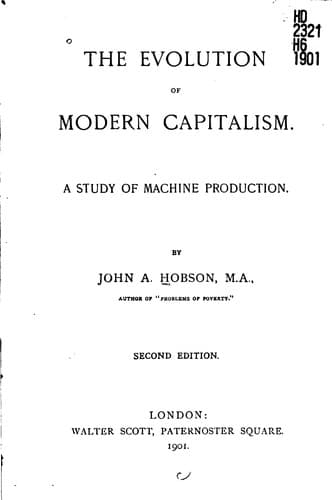
The Evolution of Modern Capitalism: A Study of Machine ProductionHobson, J. A. (John Atkinson)
History
The Evolution of Modern Capitalism: A Study of Machine Production
Hobson, J. A. (John Atkinson)
Capitalism; Industries -- History; Machinery in the workplace
(3) Largely determined by the two groups of influences named above are
the forces which represent the national character at any given time,
the outcome of primitive race characteristics, food supply, speed and
direction of industrial development, density of population, and the
various other causes which enter in to determine efficiency of labour.
The play of these natural and human forces in world-competition leads
to such a settlement of different industries in different localities
as yields the greatest net productiveness of labour in each part.
§ 11. But this world-competition, however free it may become, can lead
to no finality, no settled appointment of industrial activity to the
several parts of the earth. Setting aside all political and other
non-economic motives, there are three reasons which render such local
stability of industry impossible.
There is first the disturbance and actual loss sustained by nature in
working up the mineral wealth of the soil, and the flora and fauna
sustained by it, into commodities which are consumed, and an exact
equivalent of which cannot be replaced. The working out of a
coal-field, the destruction of forests which reacts upon the
elementary climatic influences, are examples of this disturbance.
Secondly, there is the progress of industrial arts, new scientific
discoveries applicable to industry. There is no reason to believe that
human knowledge can reach any final goal: there is infinity alike in
the resources of nature and in the capacity of the development of
human skill.
Lastly, as human life continues, the art of living must continually
change, and each change alters the value attached to the several forms
of consumption, and so to the industrial processes engaged in the
supply of different utilities. New wants stimulate new arts, new arts
alter the disposition of productive industry, giving value to new
portions of the earth. Ignoring those new material wants which require
new kinds of raw material to be worked up for their satisfaction, the
growing appreciation of certain kinds of sport, the love of fine
scenery, a rising value set upon healthy atmosphere, are beginning to
exercise a more and more perceptible influence upon the localisation
of certain classes of population and industry in the more progressive
nations of the world.
Public-domain text, read in full here on John Shaqi.
Reviews
Reviews
No reviews yet
Be the first to share your thoughts on this work.
Elsewhere in the archive
Join the Discussion
Join the discussion
Sign in to leave a comment or review.
Sign InorCreate an account