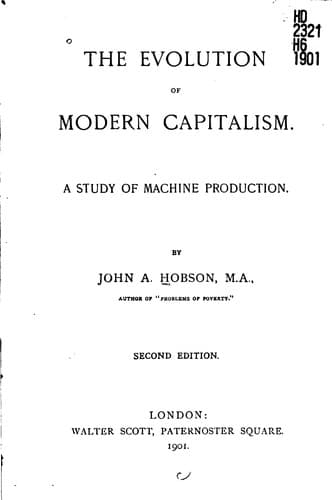
The Evolution of Modern Capitalism: A Study of Machine ProductionHobson, J. A. (John Atkinson)
History
The Evolution of Modern Capitalism: A Study of Machine Production
Hobson, J. A. (John Atkinson)
Capitalism; Industries -- History; Machinery in the workplace
The specialisation of function in a large town is, however, qualified
in two ways. The strong local organisation of a staple trade requires
the grouping round it of a number of secondary or auxiliary trades. In
large textile towns the manufactures of textile machinery, and of
subsidiary materials, are found. The machine-making of Manchester is
one of its most important industries, furnishing the neighbouring
textile towns. Leeds is similarly equipped for the woollen trade. This
is one of the respects in which the superior development of the
English cotton industry over the continental ones is indicated. In
Alsace alone of the continental centres has the concentration of
industry advanced so far as to furnish a local machine industry
specially devoted to cotton machinery. Germany is still mainly
dependent upon England for her machines.[121] So likewise with regard
to co-ordinate trades, there is an advantage in the leading processes
being grouped in local proximity, though they are not united in the
same business. Thus we find dye-works and the various branches of the
clothing trade largely settled in the large textile towns, such as
Leeds, Bradford, Manchester, Bolton. The unit of local specialisation
is thus seen to be not a single trade, but a group of closely allied
trades, co ordinate, dependent, and derivative.
Round some large industries in which men find employment minor
parasitic industries spring up stimulated by the supply of cheap
abundant labour of women and children. In metal and machine towns such
as Birmingham, Dudley, Walsall, in Newcastle-on-Tyne, and other
shipbuilding towns, where the staple industries are a masculine
monopoly, textile factories have been planted. The same holds of
various mining villages and of agricultural villages in the
neighbourhood of large textile centres. There is in the midland
counties a growing disposition to place textile factories in rural
villages where cheap female labour can be got, and where the
independence of workers is qualified by stronger local attachments and
inferior capacity of effective trade union organisation. As textile
work passes more and more into the hands of women,[122] this tendency
to make it a parasitic trade thriving upon the low wages for which
women's labour can be got where strong and well-paid male work is
established, will probably be more strongly operative.
Public-domain text, read in full here on John Shaqi.
Reviews
Reviews
No reviews yet
Be the first to share your thoughts on this work.
Elsewhere in the archive
Join the Discussion
Join the discussion
Sign in to leave a comment or review.
Sign InorCreate an account