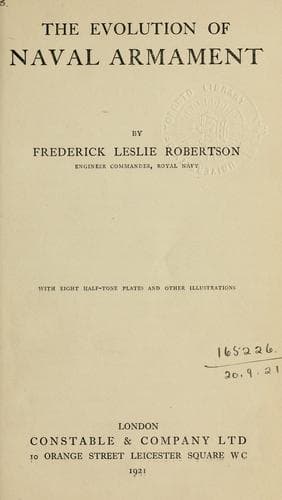
The Evolution of Naval ArmamentRobertson, Frederick Leslie
History
The Evolution of Naval Armament
Robertson, Frederick Leslie
Naval art and science -- History; Ordnance, Naval -- History; Warships -- History
Throughout the long war which broke out ten years later the carronade
played a considerable part in the succession of duels and actions which
had their climax off Trafalgar. It was now generally adopted as a
secondary form of armament, captains being permitted, upon application,
to vary at discretion the proportion of long-gun to carronade armament
which they wished to carry. In the smaller classes especially, a
preponderance of carronades was frequently accepted; the accession
of force caused by the substitution of small carronades for 6-and
9-pounder long guns in brigs and sloops could hardly be disputed. In
ships-of-the-line the larger sizes continued in favour. The French now
benefited, too, by their adoption; on more than one occasion their
poop and forecastle carronades, loaded with langrage, played havoc
with our personnel. Spaniards and Dutchmen did not carry them. How far
their absence contributed to their defeats it is not now to inquire;
but how the tide of battle would have been affected by them--if the
Dutch fleet, for instance, had carried them at Camperdown--may be a not
unprofitable speculation.
Early in the war the carronade system was to score its greatest
defensive triumph, and this, by a happy coincidence, in the hands of
the old _Rainbow’s_ commander.
The _Glatton_, one of a few East Indiamen which had been bought by the
admiralty, was fitted out in 1795 as a ship of war, and left Sheerness
in the summer of the following year under the command of Captain Henry
Trollope to join a squadron in the North Sea. At her commander’s
request she was armed with carronades exclusively. She was without
ahead or astern fire, without a single long bow or stern chaser; she
carried 68-pounder carronades along her sides, whose muzzles were so
large that they almost filled the small port-holes of the converted
Indiaman and prevented more than a small traverse. Off the Flanders
coast she fell in one night with six French frigates, a brig-corvette,
and a cutter; and at ten o’clock a close action began. The _Glatton_
was engaged by her antagonists on both sides, her yard-arms almost
touching those of the enemy. She proved to be a very dangerous foe.
Her carronades, skilfully pointed and served by supply parties who
worked port and starboard pieces alternately, poured out their heavy
missiles at point-blank range. So heavy was her fire that one by one
the frigates had to haul off, severely damaged, and the _Glatton_ was
left at last to spend the night repairing her rigging unmolested, but
in the expectation that the French commodore would renew the attack in
the morning. To her surprise no action was offered. The blows of the
68-pounders had done their work. Followed by the _Glatton_ with a “brag
countenance,” the enemy retired with his squadron in the direction of
Flushing.
The action had more than one lesson to teach, however, and no more
ships, except small craft, were armed after this upon the model of the
_Glatton_.
Public-domain text, read in full here on John Shaqi.
Reviews
Reviews
No reviews yet
Be the first to share your thoughts on this work.
Elsewhere in the archive
Join the Discussion
Join the discussion
Sign in to leave a comment or review.
Sign InorCreate an account