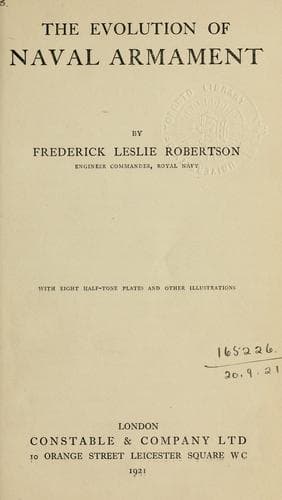
The Evolution of Naval ArmamentRobertson, Frederick Leslie
History
The Evolution of Naval Armament
Robertson, Frederick Leslie
Naval art and science -- History; Ordnance, Naval -- History; Warships -- History
We must at this point mention an experiment made in the year 1796,
at the instance of Sir Samuel Bentham, in the mounting of carronades
on a non-recoil system. Sir Samuel, who in the service of Russia had
armed long-boats and other craft with ordnance thus mounted, produced
arguments before the navy board for attaching carronades rigidly to
ships’ timbers; so as to allow of no other recoil than that resulting
from the elasticity of the carriage and the materials connecting it
to the ship. The ordnance board reported against the new idea. Sir
Samuel pointed out that the idea was not new. Both the largest and the
smallest pieces used on board ship (viz. the mortar and the swivel)
had always been mounted on the principle of non-recoil. He showed
how bad was the principle of first allowing a gun and its slide or
carriage to generate momentum in recoil and then of attempting to
absorb that momentum in the small stretch of a breeching-rope. He
argued that a rifle held at the shoulder is not allowed to recoil: if
it is, the rifleman smarts for it. He instanced the lashing of guns
fast to the ship, especially in chase, for the purpose of making them
carry farther. No; the novelty consisted in preparing suitable and
appropriate fastenings for intermediate sizes of guns between the
mortar and the swivel. The adoption of his proposal, he contended,
would result in smaller guns’ crews, quicker loading, and greater
safety.
As a result of these arguments certain sloops designed by him were
armed on this principle; and in other cases, notably in the case
of the boats used at the siege of Acre, the carronades and smaller
types of long gun were successfully mounted and worked without recoil
by attaching their carriages to vertical fir posts, built into the
hull structures to serve as front pivots. But, generally, the system
was found to be impracticable. The pivots successfully withstood
the stresses of carronades fired with normal charges of powder; no
permanent injury resulted to the elastic hull structures over which the
blows were spread. But the factor of safety allowed by this arrangement
was insufficient to cover the wild use of ordnance in emergencies.
The regulation of charges and the prevention of double-shotting was
difficult in action, and pieces were liable to be over-charged in the
excitement of battle in a way which Sir Samuel Bentham had failed to
realize. Pivots were broken, ships’ structures strained, and the whole
system found ill-adapted for warship requirements.
Public-domain text, read in full here on John Shaqi.
Reviews
Reviews
No reviews yet
Be the first to share your thoughts on this work.
Elsewhere in the archive
Join the Discussion
Join the discussion
Sign in to leave a comment or review.
Sign InorCreate an account