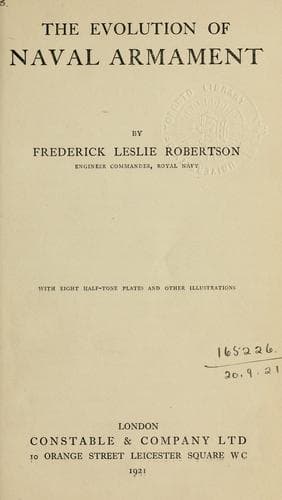
The Evolution of Naval ArmamentRobertson, Frederick Leslie
History
The Evolution of Naval Armament
Robertson, Frederick Leslie
Naval art and science -- History; Ordnance, Naval -- History; Warships -- History
It was not till the war of 1812 that the fatal weakness of the
carronade, as primary armament, was fully revealed. The Americans had
not developed the carronade policy to the same extent as ourselves,
for transatlantic opinion was never at this period enamoured of the
short-range gun. Their well-built merchant ships, unhampered by tonnage
rules or by the convoy system which had taken so much of the stamina
from British shipping, were accustomed to trust to their speed and
good seamanship to keep an enemy at a distance. Their frigates, built
under less pedantic restrictions as to size and weight, were generally
swifter, stouter and more heavily armed than ours. And, though they
included carronades among their armament, these were not generally in
so large a proportion as in our ships, and in part were represented
by a superior type--the colombiad, a hybrid weapon of proportions
intermediate between the carronade and the long gun. Our ships often
depended heavily upon the carronade element of their armament.
Experience was soon to confirm what foresight might, surely, have
deduced: namely, that when pitted against an enemy who could choose his
range and shoot with tolerable accuracy the carronade would find itself
in certain circumstances reduced to absolute impotence.
This was to be the fate and predicament of our ships on Lakes Erie and
Ontario, in face of the Americans. “I found it impossible to bring
them to close action,” the English commodore reported. “We remained in
this mortifying situation five hours, having only six guns in all the
squadron that would reach the enemy, not a carronade being fired.” The
same lesson was to be enforced shortly afterwards on the Americans.
One of their frigates, the _Essex_, armed almost exclusively with
carronades, was fought by an English ship, the _Phœbe_, armed with
long guns. The _Essex_, it should be noted, possessed the quality
essential for a carronade armament, namely, superior speed. But the
_Phœbe_ fell in with her in circumstances when, owing to damage, her
superior speed could not be utilized. The captain of the _Phœbe_ was
able to choose the range at which the action should be fought. He kept
at a “respectful distance”: within range of his own long guns and out
of range of his opponent’s carronades. Both sides fought well, but the
result was a foregone conclusion. The _Essex_, disabled and on fire,
had to surrender. From that time the carronade was discredited. For
some years after the peace it found a place in the armament of all
classes of British ships, but it was a fallen favourite. The French
commission which visited this country in 1835 reported that, although
still accounted part of the regular armament of older ships, the
carronade was being replaced to a great extent by light long guns in
newer construction. Opinion certainly hardened more and more against
the type, and, gradually falling into disuse, it was at last altogether
abandoned.
Public-domain text, read in full here on John Shaqi.
Reviews
Reviews
No reviews yet
Be the first to share your thoughts on this work.
Elsewhere in the archive
Join the Discussion
Join the discussion
Sign in to leave a comment or review.
Sign InorCreate an account