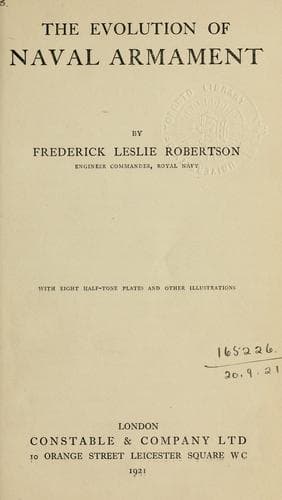
The Evolution of Naval ArmamentRobertson, Frederick Leslie
History
The Evolution of Naval Armament
Robertson, Frederick Leslie
Naval art and science -- History; Ordnance, Naval -- History; Warships -- History
So far shell fire had developed on land. In sea warfare the solid
cannon ball remained the orthodox missile; the use of explosive or
incendiary shells was deemed so dangerous a practice as to forbid
its acceptance by the great maritime powers, save in exceptional
cases, until the nineteenth century. Toward the end of the eighteenth
century serious consideration was given, by France especially, to the
possibilities of shell fire. Frenchmen felt restless and dissatisfied
with the conditions in which they were waging war with England. Sea
ordnance, which in the past had wrought so much by the destruction
of personnel, was becoming increasingly impotent, not only against
personnel but against ships themselves. Trafalgar came as a proof
of this, when not a single ship was sunk by gunfire. Sea fighting
was again resolving itself into a straightforward physical struggle
between the guns’ crews of the opposing fleets, in which struggle
the victory went by attrition to the side which plied its guns with
the greatest rapidity and perseverance. Élan, enthusiasm, science,
the mental alertness of the individual, were bound to be overborne
in such a case by superior endurance, physique, coolness, and sound
workmanship. Both sides had a profound belief in the superiority of
their personnel in hand-to-hand conflict. Where fighting was, as in
the earliest days of the rival navies, “man to man, lance to lance,
arrow to arrow, stone to stone,” success depended entirely upon
courage and physical strength; and in such cases, says Nicolas, the
English were almost always victorious. If, stated a French writer, sea
actions could be decided by hand-to-hand combat the arms of France
would triumph. But sea fights were in fact almost solely a matter of
artillery. If only the conditions of battle could be altered; if only
the forces of incendiarism or explosion could be summoned to put the
enemy ships-of-the-line in jeopardy, a short cut to victory might be
found or, at any rate, the superiority of England in material might be
seriously depreciated.
[Illustration]
Some time was to elapse, however, before France was to see even the
partial consummation of this fervent desire.
Public-domain text, read in full here on John Shaqi.
Reviews
Reviews
No reviews yet
Be the first to share your thoughts on this work.
Elsewhere in the archive
Join the Discussion
Join the discussion
Sign in to leave a comment or review.
Sign InorCreate an account