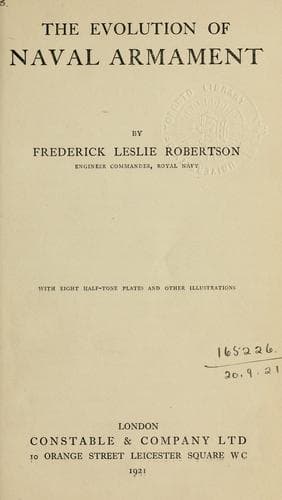
The Evolution of Naval ArmamentRobertson, Frederick Leslie
History
The Evolution of Naval Armament
Robertson, Frederick Leslie
Naval art and science -- History; Ordnance, Naval -- History; Warships -- History
While the use of grenades, bombs, carcasses and other explosive
and incendiary missiles had been recognized on land for centuries,
an event occurred in the year 1788 which, coming to the ears of
Europe, should have had considerable effect in turning the thoughts
of artillerists to the possibilities of their use at sea. In that
year, some sixty-five years before the action off Sinope, a Deptford
shipwright who had risen to high service under the Russian government
fitted out for his employers a flotilla of long-boats for an attack
upon a Turkish squadron. These long-boats Sir Samuel Bentham--he was
the ex-shipwright--armed with brass ordnance mounted on his favourite
non-recoil system, and for them he requisitioned a large supply of
shells, carcasses and solid shot. At the mouth of the Liman river in
the Sea of Azov the Russians, with these insignificant war vessels,
attacked a very superior force of Turkish ships, and gained a complete
victory. The effect of the shells, fired at close range into the
Turkish ships, was startling and impressive. Great holes were torn in
the sides of the vessels, and fires were started which, in a favouring
medium of dry timber and paint and pitch, rapidly spread and caused the
squadron’s destruction.
No evidence can be quoted, it must be admitted, to show that
contemporary opinion realized how portentous was this sea action;
no stress is laid on the event in histories relating to that time.
Nor does another event which occurred at this period appear to have
caused the notice it deserved: the firing, at the suggestion of a
Captain Mercier, 35th Regiment, of mortar shells from the British
long 24-pounders, from Gibraltar into the Spanish lines.[100] Nor
was Lieutenant Shrapnel’s contemporaneous invention,[101] of a
shell containing case shot explodable by a small bursting charge,
developed or the possible adaptation of its use for sea warfare fully
appreciated. Or, if authority did discern the eventual effect of these
innovations, a wholesome dread of their extension and development
in naval warfare appears to have dictated a policy of calculated
conservatism in respect of them, a suppression of all ideas and
experiments which had in view any intensifying or improvement of
our artillery methods. “So long as foreign powers did not innovate
by improving their guns, by extending the use of carronades and,
above all, by projecting shells horizontally from shipping; so long
it was our interest not to set the example of any improvement in
naval ordnance--the value of our immense material might otherwise be
depreciated. Many of the defects which were known to exist, so long
as they were common to all navies, operated to the advantage of Great
Britain.”[102]
Public-domain text, read in full here on John Shaqi.
Reviews
Reviews
No reviews yet
Be the first to share your thoughts on this work.
Elsewhere in the archive
Join the Discussion
Join the discussion
Sign in to leave a comment or review.
Sign InorCreate an account