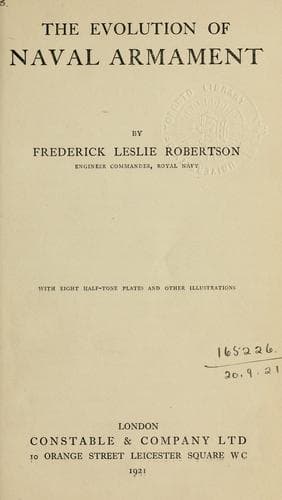
The Evolution of Naval ArmamentRobertson, Frederick Leslie
History
The Evolution of Naval Armament
Robertson, Frederick Leslie
Naval art and science -- History; Ordnance, Naval -- History; Warships -- History
On these two principles M. Paixhans reared and elaborated in minutest
detail the revolutionary system with which his name is associated.
No new element or discovery was necessary for giving effect to his
designs. Indeed he expressly disclaimed having introduced any novelty:
“Nous n’avons donc rien inventé, rien innové, et presque rien changé;
nous avons seulement réuni des élémens épars, auxquels il suffisait
de donner, avec un peu d’attention, la grandeur et les proportions
convenables, pour atteindre le but important que nous étions proposé.”
It may be said, in fact, that unity of calibre had been an ideal sought
for years before M. Paixhans’ time; while shell fire, the New Arm of
1822, was almost the logical consequence of Robins’ discoveries in
the principles of gunnery, extended as they were by the researches
of Doctors Hutton and Gregory. In particular, mention is made by M.
Paixhans himself of two of the results brought out by Dr. Hutton’s
experiments: one, that the length of the bore of a gun has but a
small effect upon the range of its projectile, the range varying as
the fifth root of the length; two, that the muzzle velocity may be
considered to be independent of the weight of the gun.
As to the lack of novelty of shell fire on ship-board, M. Paixhans
gives a significant extract from French naval annals. In 1690, it
appears, a M. Deschiens had invented a means of firing bombs from long
guns horizontally, instead of parabolically as from mortars. This
secret was of great use to him; for, falling in with four English ships
at sea, he so surprised them by this new invention that, fearful of
being set on fire, they drew off and did not attempt to renew battle.
This same French captain at a later date attacked two Dutch ships more
than a match for him, and, by means of these horizontally fired bombs,
sank one and disabled the other. But M. Deschiens died and his secret
with him; though, as M. Paixhans remarks, this “secret” would have been
easy to find if anyone had looked for it.
A whole chapter of _The Genuine Use and Effects of the Gunne_, written
by Robert Anderson and published at London in 1674, concerns “the
shooting of Granados out of Long Gunnes.”
Public-domain text, read in full here on John Shaqi.
Reviews
Reviews
No reviews yet
Be the first to share your thoughts on this work.
Elsewhere in the archive
Join the Discussion
Join the discussion
Sign in to leave a comment or review.
Sign InorCreate an account