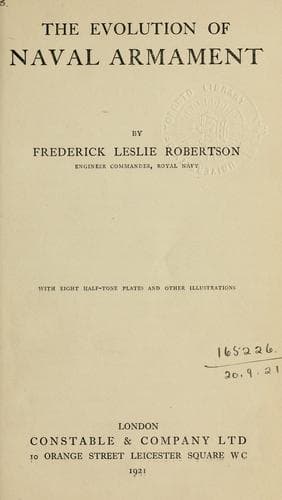
The Evolution of Naval ArmamentRobertson, Frederick Leslie
History
The Evolution of Naval Armament
Robertson, Frederick Leslie
Naval art and science -- History; Ordnance, Naval -- History; Warships -- History
The might of England, avouches the historian, stood upon archers. The
prowess of the archer, the dreadful precision of the longbow, and the
athletic arm by which it was strung, form the constant and animated
theme of ancient British story. In battle and the chase, we are told,
the power of the archers always prevailed, and the attainment of that
power was an object of incessant anxiety, in all ranks of people,
from their earliest infancy. The longbow was thus, as described in
the above-quoted act of Henry VIII, a continual defence of the realm.
Over all other countries England had this advantage, that against the
exigencies of war she had, not only her race of splendid seamen, but
armies of the most skilful archers in the world. In peace she was thus
well prepared. Good use was made by legislation to maintain the skill
and stimulate the ardour of the bowmen, and the statute book bears
witness, reign after reign, to the importance attached to archery from
its military aspect. At one time every man between the ages of fifteen
and sixty had to possess a bow equal in length to his own height. Every
township had to maintain its butts, each saint’s day had its shooting
competition. The churchyard yew gave its wood for staves, the geese on
the green their best wing feathers; and a goose’s head was the orthodox
and inconspicuous target. No man under the age of twenty-four was
allowed to shoot at any standing mark, and none over that age at any
mark of eleven score yards or under. Restraint was laid on the exercise
of sports which might interfere with archery, and when the mechanically
strung crossbow was introduced its use was forbidden except under
special conditions.[111] Honours and prizes were awarded the best
marksmen. The range and accuracy achieved by them was without doubt
prodigious. Much of their power lay in their strength of arm; but one
of the chief secrets of their craft lay in the way in which they set
their arrow-feathers at the requisite angle to give the arrows a spin
which would ensure a long, a true and a steady flight.
With the advent of gunpowder the shooting competitions declined. An
embargo was put on fire-arms; instead of being pressed to possess
them the people were forbidden their use except under conditions. The
military character became a separate order in society. Encouragement
was no longer given to the individual to own and master the unwieldy
fire-arm. The English peasant, enthusiasm evaporating as his skill
declined, no longer gave the State the military value which his
forefathers possessed. The clumsy mechanism of the English musket, the
uncertainty of its action (especially in wet weather), its slow rate
of fire, its gross inaccuracy, and its inability to penetrate armour
under all conditions, were factors which kept fire-arms for long years
in disfavour in this country.
Public-domain text, read in full here on John Shaqi.
Reviews
Reviews
No reviews yet
Be the first to share your thoughts on this work.
Elsewhere in the archive
Join the Discussion
Join the discussion
Sign in to leave a comment or review.
Sign InorCreate an account