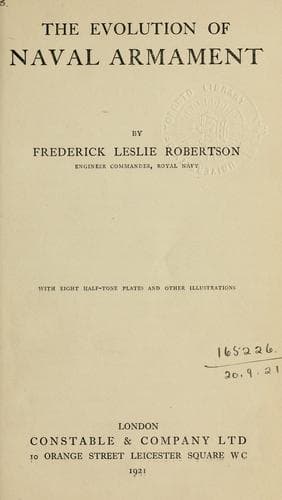
The Evolution of Naval ArmamentRobertson, Frederick Leslie
History
The Evolution of Naval Armament
Robertson, Frederick Leslie
Naval art and science -- History; Ordnance, Naval -- History; Warships -- History
Abroad, on the other hand, the development of fire-arms was actually
encouraged and skill in their use patronised. The rivalry which already
existed with bow and arrow was extended to the new medium, and in
Sweden and Switzerland, Germany and France, shooting competitions
continued in vogue and proficiency with musket and arquebus was
honoured and substantially rewarded. In Switzerland and Southern
Germany especially, shooting was very popular. The character of the
people, their skill in making delicate mechanisms, the nature of the
country, all tended to promote an interest in musketry which did not
exist among our own people. As a result England has little to claim in
the early stages of the development of portable fire-arms.
During the fourteenth and fifteenth centuries smooth-bore weapons
firing spherical lead balls were the only kind known and used. But in
the early part of the sixteenth century a development took place which
was to prove of the first importance to fire-arms; which was to make
the primitive weapon in the course of time “the most beautiful, and at
the same time the most deadly instrument of warfare ever devised by the
ingenuity of man.” The value of rifling was discovered.
How, when, or where this discovery was first made, appears to have
defied the researches of investigators. As to the manner in which
the development took place and the effects which it was intended to
produce by its means there is an assortment of evidence; and this is so
various and so interesting as bearing on the action of the rifle and
its evolution, that we reproduce it in some detail. On one point there
appears to be small doubt: _The earliest rifling had no twist in it_.
“It seems to have been generally accepted by writers on the subject,”
says the author of _The Book of the Rifle_, “that the earliest
barrels had straight grooves, the object of which was to give a space
into which the fouling of previous shots might stow itself without
obstructing the process of loading with a well-fitting ball, and that
spiral grooving was merely an accidental variation of this, afterwards
found to possess special advantages.” Nevertheless, he himself inclines
to the opinion that the straight groove was not necessarily a prior
form of the spiral. The collections in museums contain examples of
spiral grooving older than the oldest straight-grooved barrels. In any
case, it is antecedently more probable, he considers, that the spiral
grooving was not a variation of the straight groove, but that it was “a
deliberate attempt to find a means of giving to the bullet the spiral
spin which was well known as having a steadying effect on the javelin,
or on the arrow or bolt discharged from the bow.”[112]
Public-domain text, read in full here on John Shaqi.
Reviews
Reviews
No reviews yet
Be the first to share your thoughts on this work.
Elsewhere in the archive
Join the Discussion
Join the discussion
Sign in to leave a comment or review.
Sign InorCreate an account