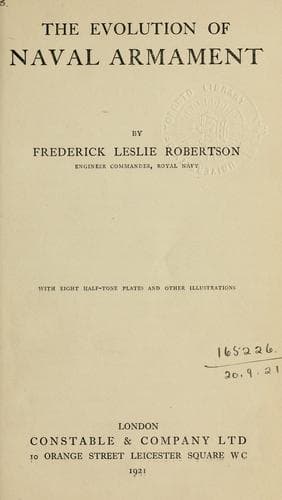
The Evolution of Naval ArmamentRobertson, Frederick Leslie
History
The Evolution of Naval Armament
Robertson, Frederick Leslie
Naval art and science -- History; Ordnance, Naval -- History; Warships -- History
We have seen how the development of field ordnance stimulated the
development of the rifle. In turn the attainment of superior range
and accuracy by rifled small arms led directly to a corresponding
development of field ordnance, designed to recover the loss of its
ascendancy. In France, where the logical consequences of the progress
in small arms were officially noted on several occasions, Napoleon
III, himself an authority on artillery, took the initiative to restore
field ordnance to its former relative position. It was in the Crimean
War that the enhanced effects of rifle regiments were first seriously
felt. Convinced by the protraction of the operations before Sebastopol
of the inadequacy of smooth-bore guns, the Emperor caused bronze pieces
to be rifled, and these, being sent to Algeria on active service, gave
conclusive proof of their increased efficiency. On report of which, all
the bronze field pieces in the French army were rifled in accordance
with the plans which a M. Treuille de Beaulieu had submitted in 1842,
viz. with six shallow rounded grooves in which engaged zinc studs
carried on two bands formed on the cylindrical projectile. The gain in
power obtained by rifling ordnance was greater even than that obtained
from rifling as applied to small arms. For not only did rifling confer
the advantages of a more massive projectile more suitably shaped for
flight through a resisting medium, but it allowed a large increase
in the number of balls which could be discharged in the form of case
or shrapnel, and a large increase in the powder-charge which could
be carried inside a common shell. An advantage was also gained in
respect of that important detail, the fusee or fuze; the rotation of
the projectile about a definite axis made it possible to use fuses
whose action depended on one definite part of the projectile coming
first in contact with the ground or target.[124] All these advantages
were found to be present in the French field pieces when rifled on the
above plan. “And thus,” said an English writer, “at slight expense
but too late for use in the Crimean War, France was put in possession
of an artillery which, consuming its usual powder and using either
round ball or elongated projectiles, proved of immense value in the war
against Austria in 1856, when, at Magenta and at Solferino, the case
shot from their rifled field-pieces ploughed through the distant masses
of opposing infantry and decimated the cavalry as they formed for the
attack.”[125]
In England an almost simultaneous development took place, but on
entirely different lines. Let us tell it in the words of Sir Emerson
Tennant:
Public-domain text, read in full here on John Shaqi.
Reviews
Reviews
No reviews yet
Be the first to share your thoughts on this work.
Elsewhere in the archive
Join the Discussion
Join the discussion
Sign in to leave a comment or review.
Sign InorCreate an account