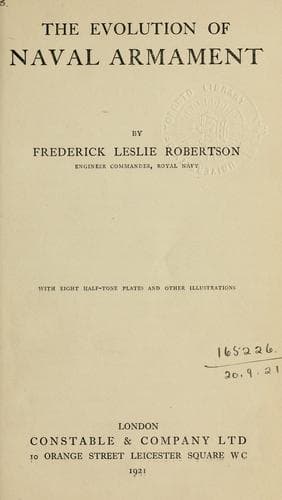
The Evolution of Naval ArmamentRobertson, Frederick Leslie
History
The Evolution of Naval Armament
Robertson, Frederick Leslie
Naval art and science -- History; Ordnance, Naval -- History; Warships -- History
“The fate of the battle of Inkerman in November, 1854, was decided
by two eighteen-pounder guns which by almost superhuman efforts were
got up late into the field, and these, by their superior range, were
effectual in silencing the Russian fire. Mr. William Armstrong was
amongst those who perceived that another such emergency could only be
met by imparting to field-guns the accuracy and range of the rifle; and
that the impediment of weight must be removed by substituting forged
instead of cast-iron guns. With his earliest design for the realization
of this conception, he waited on the Secretary for War in December,
1854, to propose the enlargement of the rifle musket to the standard of
a field gun, and to substitute elongated projectiles of lead instead
of balls of cast iron. Encouraged by the Duke of Newcastle, he put
together his first wrought-iron gun in the spring of 1855.”[126]
The manufacture of this gun marked a new era in ordnance. Repeated
trials followed its completion; with the result that in 1858 the
Armstrong gun was officially adopted for service in the field,--the
epoch-making Armstrong gun: a tube made of wrought-iron bar coiled in
a closed helix and welded at a white heat into a solid mass; turned
to a true cylinder and reinforced by outer tubes shrunk on to it;
rifled with a large number of grooves; breech-loading, a powerful screw
holding a sliding vent-piece tightly against the face of the breech;
firing a lead-coated projectile in whose plastic covering the rifling
engaged as soon as it started its passage through the bore; and mounted
on a field-carriage in such a way that the gun could recoil up an
inclined slide and return by gravity, and in such a way that its motion
both for elevating and for traversing was under the accurate control
given by screw gearing.
Public-domain text, read in full here on John Shaqi.
Reviews
Reviews
No reviews yet
Be the first to share your thoughts on this work.
Elsewhere in the archive
Join the Discussion
Join the discussion
Sign in to leave a comment or review.
Sign InorCreate an account