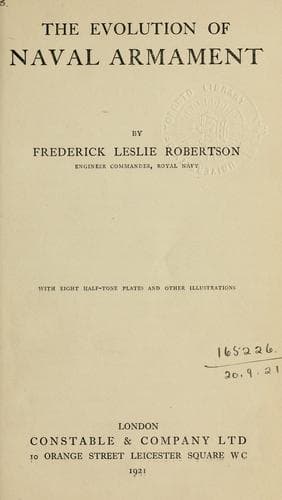
The Evolution of Naval ArmamentRobertson, Frederick Leslie
History
The Evolution of Naval Armament
Robertson, Frederick Leslie
Naval art and science -- History; Ordnance, Naval -- History; Warships -- History
In the meantime Savery in England had produced his successful engine.
In his case, too, the claim has been made that he first proposed steam
propulsion for ships. But in his _Miner’s Friend_ this able mechanician
showed that he recognized the limited application of his steam engine.
“I believe,” he says, “it may be made very _useful_ to ships, but I
dare not meddle with that matter; and leave it to the judgment of those
who are the best judges of maritime affairs.” But in propulsion by
hand-operated paddlewheels Savery was an enthusiastic believer. In 1698
he had published, in a book bearing the title, “_Navigation Improv’d:
Or the Art of Rowing Ships of all Rates, in Calms, with a more easy,
swift, and steady Motion than Oars can_,” a description of a mechanism
consisting of paddlewheels formed of oars fitted radially to drumheads
which were mounted on the two ends of an iron bar placed horizontally
across the ship. This bar was geared by mortice wheels with another
bar mounted vertically as the axis of a capstan; rotation of the
capstan was thus transmitted to the paddlewheels. Savery fitted this
mechanism to a wherry and carried out successful trials on the Thames
before thousands of people. But the Navy Board would not consider it.
They had incurred a loss, it appeared, on a horse tow-vessel which had
been in use at Chatham a few years previously: a vessel which towed
the greatest ships with the help of four, six, or eight horses, and
which, incidentally, may have influenced Savery in adopting the term
“horse power” as the unit of work for his steam engine. The sanguine
inventor made great efforts to interest the authorities, but without
avail; the Surveyor rejected the proposal. So in an angry mood Savery
published his book, with a description of his mechanism and an account
of his efforts to interest the authorities, to show how one man’s
humour had obstructed his engine. “You see, Reader, what to trust to,”
he concluded, “though you have found out an improvement as great to
shipping as turning to windward, or the compass; unless you can sit
round the green table in Crutched Friars, your invention is damned of
course.”
Public-domain text, read in full here on John Shaqi.
Reviews
Reviews
No reviews yet
Be the first to share your thoughts on this work.
Elsewhere in the archive
Join the Discussion
Join the discussion
Sign in to leave a comment or review.
Sign InorCreate an account