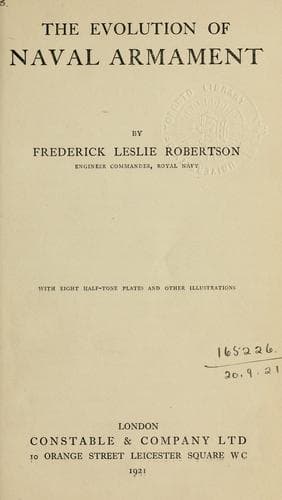
The Evolution of Naval ArmamentRobertson, Frederick Leslie
History
The Evolution of Naval Armament
Robertson, Frederick Leslie
Naval art and science -- History; Ordnance, Naval -- History; Warships -- History
The first detailed scheme for applying steam-power to ship propulsion
was contained in the patent of Jonathan Hulls, in 1736. Though great
credit is generally given to this inventor (who has even been dubbed
the father of steam navigation), it does not appear that in reality
he contributed much to the advancement of the problem; which was,
indeed, still waiting on the development of the steam engine. Hulls’
notion, explained in a pamphlet which he published in 1737, was to
connect the piston of a Newcomen engine by a rope gearing with some
wheels mounted in the waist of the vessel, which wheels oscillated as
the piston moved up and down. These wheels were in turn connected by
rope gearing with a large fan-wheel mounted in a frame rigged out over
the vessel’s stern, the fans in their lowest position dipping into
the water. The oscillating motion of the inboard wheels was converted
into a continuous ahead motion of the fan-wheel by means of a ratchet.
With this machinery he designed to tow ships in harbours and rivers.
It must, however, be remarked that the invention was never more than
a paper project; and that if Hulls had tried to translate his ideas
into three dimensions he would have encountered, in all probability,
insuperable practical difficulties. One very original suggestion of
his certainly deserves notice; as a special case he proposed that when
the tow-boat was used in shallow rivers two cranks, fitted to the axis
of his driving wheels, should operate two long poles of sufficient
length to reach the bottom of the river; these trailing poles, moving
alternately forward, would propel the vessel. Here is an early
application of the crank. But in this case it will be noted that the
crank is driven, and that it converts a rotary into a reciprocating
motion; in short, it is an inversion of the driving crank which, as
applied to the steam engine, was not invented till some years later.
Public-domain text, read in full here on John Shaqi.
Reviews
Reviews
No reviews yet
Be the first to share your thoughts on this work.
Elsewhere in the archive
Join the Discussion
Join the discussion
Sign in to leave a comment or review.
Sign InorCreate an account