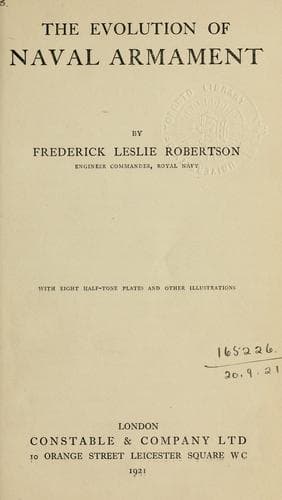
The Evolution of Naval ArmamentRobertson, Frederick Leslie
History
The Evolution of Naval Armament
Robertson, Frederick Leslie
Naval art and science -- History; Ordnance, Naval -- History; Warships -- History
Iron ships, on the other hand, were found to be well adapted to
withstand the racking stresses, the localized loads and the vibrations
which were introduced by steam machinery; they were lighter than
wooden ships, more capacious, more easily shaped to give the fine
lines necessary for speed, cheaper and immeasurably stronger. In
course of time the objections to them gradually vanished; by aid of
the scientists the derangement of their compasses was overcome, the
dangers from lightning were obviated, and the extent of the fouling to
which their surfaces were liable was kept within limits. In course of
time, in spite of natural preference and vested interest, and since
the advantages of iron were confirmed by continuous experience, wood
became almost entirely superseded by the metal for large mercantile
construction. But in the case of warships, as we have seen, insuperable
objections seemed to prohibit the change of material. No sooner had a
step been taken by the Admiralty, in the ordering of a group of iron
paddlewheel frigates in ’43, than an outcry arose; the wooden walls
of England were in danger, the opponents of iron declared, and iron
ships were wholly unsuitable for warlike purposes. More were ordered in
’46. Sir Charles Napier, whose opinion naturally carried great weight
with the public, led the opposition, and when, in ’49, the artillery
trial demonstrated the dangerous effects of shot and shell on thin iron
plates, the advocates of iron were fain to admit the error of their
opinions. The iron frigates were struck from the establishment and
transformed--such of them as were completed--into unarmed transports.
As experience with iron ships accumulated, the feeling grew in
certain quarters that the artillery trials, the results of which had
been claimed as being decisive proof of the unsuitability of iron
for warships, might not have been the last word upon the subject.
The events of the Crimean War tended to emphasize the doubt and
uncertainty. A few there were who saw in that war clear proofs of the
superiority of iron over wood; who argued that, though iron had proved
to be dangerous in the form of thin plates in certain circumstances,
yet it had shown itself to be impervious both to shot and shell, and
indeed an indispensable defence in certain circumstances when applied
in sufficient thickness; that thicker plates than those condemned as
dangerous might therefore prove to be a great protection against shell
fire; and that, even as regards thin plates, the splintering effect of
shell against these was small, from all accounts, compared with the
_incendiary_ effect of shell against timber. And in what other respects
were the advantages of iron contested?
Public-domain text, read in full here on John Shaqi.
Reviews
Reviews
No reviews yet
Be the first to share your thoughts on this work.
Elsewhere in the archive
Join the Discussion
Join the discussion
Sign in to leave a comment or review.
Sign InorCreate an account