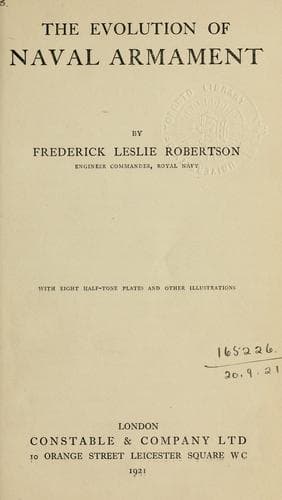
The Evolution of Naval ArmamentRobertson, Frederick Leslie
History
The Evolution of Naval Armament
Robertson, Frederick Leslie
Naval art and science -- History; Ordnance, Naval -- History; Warships -- History
But, acting upon expert advice and influence, doubtless, by the
remembrance of the _Birkenhead_ and _Simoon_ fiasco, the government
still felt unable to sanction the use of iron, and it was not until
news of the laying down of the _Gloire_ reached England that a decision
was made to adopt the new material, both as armour and for the hulls of
warships.
The high protagonist of timber-built ships, it was shortly afterwards
revealed, was Sir Howard Douglas: the most strenuous advocate of iron
was John Scott Russell. For years, it appeared, Sir Howard had been
the influential and successful adviser of the government against the
adoption of iron. “I was consulted by Sir Robert Peel,” he wrote
in 1860, “on his accession to the government, as to the use and
efficiency of a certain half-dozen iron frigates, two of which were
finished, and four constructing by contract. I stated in reply that
vessels wholly constructed of iron were utterly unfit for all the
purposes of war, whether armed or as transports for the conveyance of
troops.” In the same paper he stated the arguments on which he had
tendered this advice; and these arguments appeared so fallacious,
and the facts on which they were based so disputable, as to seem to
call for some reply from the builders of iron ships. Sir Howard had
certainly strayed far from science in his unsupported statements
as to the calamitous effects of iron if used for warships; and
unfortunately he had allowed himself to stigmatize the _Great Eastern_,
as representative of iron ships generally, as “an awful roller,” and
as never having attained anything like her calculated speed. Scott
Russell made a violent reply. “After establishing that Sir H. Douglas’s
conclusions are the reverse of the truth,” he began, “I shall proceed
to establish that the future navy of England must be an iron navy. That
its construction must be founded on facts and principles, which Sir H.
Douglas’s writings ignore, and his deductions contradict; and I believe
I shall prove that if iron ships had been introduced at the time
when Sir Howard says he sedulously and systematically opposed their
introduction, the money which has been spent on a wooden fleet about to
become valueless would have given England a fleet greatly more powerful
than the combined navies of the world.”[163]
Public-domain text, read in full here on John Shaqi.
Reviews
Reviews
No reviews yet
Be the first to share your thoughts on this work.
Elsewhere in the archive
Join the Discussion
Join the discussion
Sign in to leave a comment or review.
Sign InorCreate an account