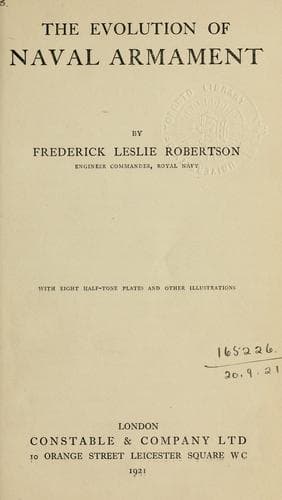
The Evolution of Naval ArmamentRobertson, Frederick Leslie
History
The Evolution of Naval Armament
Robertson, Frederick Leslie
Naval art and science -- History; Ordnance, Naval -- History; Warships -- History
The germ of the central-battery idea may be seen, perhaps, in the
belted _Minotaur_, in which, in order to allow the chase guns to be
fought from behind armour, a transverse armour bulkhead was worked, at
a distance of some 25 feet aft of the bow. Had foreign influence not
exerted itself it may be supposed with reason that from the _Minotaur_
the central battery would have been evolved. However this may be, the
evolution was hastened by French initiative; for in each of the two
wooden ships _Magenta_ and _Solferino_, laid down in ’59, was found a
complete two-decked central battery whose whole depth was faced with
armour for the protection of fifty-two 5-ton cannon, the rest of the
ship’s water-line being protected by an armour belt much narrower than
that of the _Gloire_. In imitation of this plan our own designs were
prepared; and gradually, and only by a series of steps, we achieved
what our rivals had obtained in a single stride.
In ’63 Sir Edward Reed, at that time Mr. Reed, one of the graduates of
the school which in ’48 had been established at Portsmouth Dockyard,
was appointed to the office of Chief Constructor of the Navy. Possessed
of broad and original views and gifted to an unusual degree in the arts
of exposition and argument, he made himself responsible for designs of
warships differing widely from their large and unwieldy precursors. The
first of these was the _Bellerophon_, a short and easily manœuvred,
fully rigged belt-and-battery ship, carrying ten 12-ton Armstrong guns
for broadside fire in the battery, and two 6-ton guns for ahead fire
in a small armoured battery in the bows. Not only in the disposition
of her armament was the _Bellerophon_ different from all former ships.
She was a radical departure from existing practice in many important
respects. Constructionally, she was built on a new “bracket-frame”
system designed to give great girder strength for small expenditure of
weight, already in vogue for mercantile shipping. The use of watertight
compartments was extended as a defence against an enemy ram, the system
of double bottoms was extended as a consequence of the introduction of
the torpedo. A powerful ram was carried, but the bow took a new form;
a U- instead of a V-section was adopted in order to give buoyancy
and thus minimize the tendency to plunge which was inherent in a
fine-bowed ship; the section near the water-line being fined away so
as to form a cut-water. Steel was largely used instead of iron, with
a consequent saving of weight. A novel trim was given her--six feet
by the stern--to give a deep immersion for the powerful screw and to
assist the ship in turning quickly on her heel under the action of
the balanced rudder; an adjustment which experience showed to have a
detrimental effect on the propulsive efficiency.
Public-domain text, read in full here on John Shaqi.
Reviews
Reviews
No reviews yet
Be the first to share your thoughts on this work.
Elsewhere in the archive
Join the Discussion
Join the discussion
Sign in to leave a comment or review.
Sign InorCreate an account