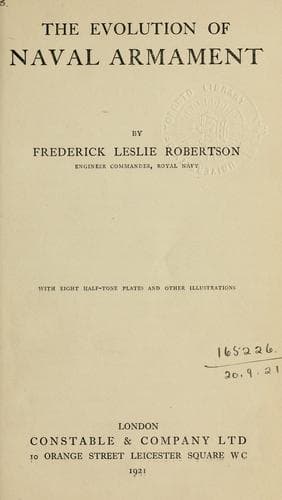
The Evolution of Naval ArmamentRobertson, Frederick Leslie
History
The Evolution of Naval Armament
Robertson, Frederick Leslie
Naval art and science -- History; Ordnance, Naval -- History; Warships -- History
[100] In Vol. IV of the _Proceedings of the Royal Artillery
Institution_, in an article by General Lefroy, an order is quoted
showing that trials were made of firing shells horizontally by the
Royal Artillery in Canada in 1776. The author also shows that the
trials made by the French in 1784-6 were brought to the notice of Lord
Nelson.
In Vol. V is the following extract: “Experiments were made on
Acton Common in 1760, to fire coehorn and royal shells from 12-and
24-pounders, in order to be applied to the sea service; but as the
shells were found frequently to burst in the guns, it was thought too
hazardous to introduce them on board ships of war.”
[101] The first public demonstration was given by Lieut. Shrapnel,
R.A., before the G.O.C., Gibraltar, in the year 1787.
[102] Simmons: _Effect of Heavy Ordnance_, 1837.
[103] James: _Naval History_.
[104] A short review of both books is given in the _Papers on Naval
Architecture_, edited by Morgan and Creuze, 1829.
[105] See Hugo’s _Toilers of the Sea_.
[106] “As for guns,” wrote Fuller in his _Worthies of England_,
comparing the relative merits of the inventions of printing and
gunpowder, “it cannot be denied, that though most behold them as
instruments of cruelty; partly, because subjecting valour to chance;
partly, because guns give no quarter (which the sword sometimes doth);
yet it will appear that, since their invention, Victory hath not stood
so long a neuter, and hath been determined with the loss of fewer
lives.”
[107] At a later date this reduction in number of types of ordnance was
extended to cover land artillery. In ’62 the French brought down the
number of different calibres to four: one for the field, one for the
siege, and two (the 30-and 50-pounders) for the navy.
[108] Dahlgren: _Shells and Shell-Guns_, 1856.
[109] By this time Denmark, Holland, Russia and Sweden had all
recognized the possibilities of shell guns, and had adopted them in
greater or less degree. By this time, too, France actually possessed
more steam war-vessels than we had ourselves.
[110] Simmons: _Effects of Heavy Ordnance_.
[111] The crossbow was looked upon as a weapon unworthy of a brave
man; a prejudice which afterwards prevailed with respect to fire-arms
(Hallam: _Middle Ages_).
[112] The Hon. T. F. Fremantle: _The Book of the Rifle_.
[113] _Le Développement des Armes à Feu_, 1870.
[114] In this aspect of the origin of the grooves there is a curious
analogy between the rifle-barrel and the drill used in machine tools.
In the primitive drill the shank is appreciably less in diameter than
the hole cut by the drill, so that the drillings can easily work their
way out of the hole. When, however, it was desired to make the shank
almost of the same diameter as the hole, so as to form a guide, it was
necessary to flute it with two grooves or more to allow the drillings
to get away. In the course of its evolution these grooves became spiral.
Public-domain text, read in full here on John Shaqi.
Reviews
Reviews
No reviews yet
Be the first to share your thoughts on this work.
Elsewhere in the archive
Join the Discussion
Join the discussion
Sign in to leave a comment or review.
Sign InorCreate an account