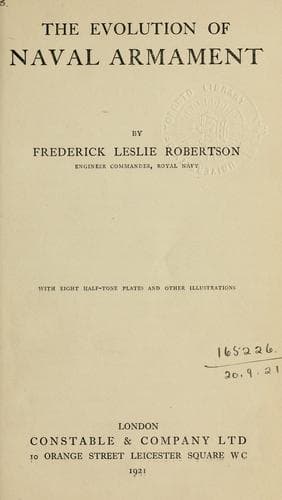
The Evolution of Naval ArmamentRobertson, Frederick Leslie
History
The Evolution of Naval Armament
Robertson, Frederick Leslie
Naval art and science -- History; Ordnance, Naval -- History; Warships -- History
[115] Quoted in _The Book of the Rifle_ from Schmidt’s _Armes à Feu
Portatives_, 1889.
[116] Delvigne: _Notice historique des armes rayées_.
[117] Beaufoy: _Scloppetaria_.
[118] A paragraph in Beaufoy’s _Scloppetaria_ (1808) shows the complete
misconception under which its author laboured as to the function of
rifling. Just as the air turns a windmill or a shuttlecock (he says),
so, after an indented ball quits its rifled barrel the air, forced
spirally along its grooves, will cause the ball to turn. In short, he
regarded the spiral grooves of a barrel as being of no further utility,
with respect to the generating of the rotary motion, than as an easy
way of giving the ball the requisite indentations.
[119] Fremantle: _The Book of the Rifle_.
[120] Captain A. Walker: _The Rifle_, 1864.
[121] At the beginning of the century Ezekiel Baker had noted that “a
wadding in the shape of an acorn cup placed on the powder, and the ball
put on the top of the cup, will expand the cup and fill the bore--and
of course the windage will be much diminished.”
[122] Mention must be made of an important prior development of the
elongated bullet which had been carried out by General Jacob in India,
quite independently of French research. General Jacob conducted, in an
altogether scientific manner, experiments the successful results of
which were communicated by him to the home government on more than one
occasion. The importance of his discoveries remained unrecognized, and
the value of his improvements was lost to this country.
[123] In military circles the possibilities of the invasion of this
country had for some time been under discussion, in view of the
increasingly aggressive temper of the French. Interest in national
defence became general with the warning letter of the Duke of
Wellington which appeared in _The Times_ on the 9th January, 1847. In
’51 was held the Great Exhibition, and for a time opinion was less
agitated. The Exhibition, it was thought and hoped by numbers of
people, would inaugurate the millennium.
[124] This advantage of the rifled gun hod been fully appreciated
by Captain Norton. As early as 1832 he had conducted trials with
one-pounder rifled cannon, to confirm his belief that the projectile
would maintain its rotation during flight and hit the target
point-first (_Journal of R.U.S.I._, 1837).
[125] Commander R. A. E. Scott, R.N.: _Journal of R.U.S.I._, Vol. VI,
1862.
[126] Tennant: _The Story of the Guns_. This book gives in detail the
controversy which arose between the advocates of the Armstrong and the
Whitworth systems.
[127] _Edinburgh Review_, 1859. Quoted by Sir E. Tennant.
Public-domain text, read in full here on John Shaqi.
Reviews
Reviews
No reviews yet
Be the first to share your thoughts on this work.
Elsewhere in the archive
Join the Discussion
Join the discussion
Sign in to leave a comment or review.
Sign InorCreate an account