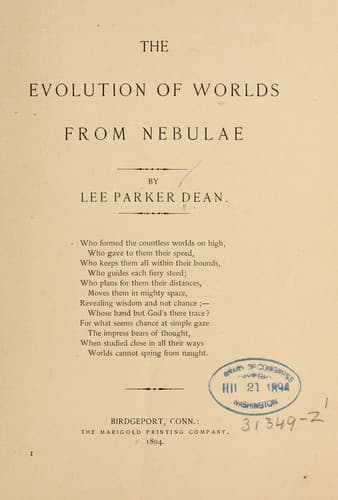
The evolution of worlds from nebulaeDean, Lee Parker
Science
The evolution of worlds from nebulae
Dean, Lee Parker
Nebular hypothesis
But, to further illustrate the magnitude of space, let us again take
the flight of light as a basis for our calculations. As there are
525,600 minutes in a year, light—moving at the rate of eleven millions
of miles each minute—must travel in one year 5,781,600 millions of
miles. With that number of miles as radius of a sphere, of which earth
is the centre, the diameter will be 11,563,200 millions of miles, and
the surface of the sphere 401,112,000 quintillions of square miles,
while it will possess a volume of about 800 undecillions of cubic
miles. Dividing this number by the 260,000 millions of cubic miles
that earth contains we have 3,000 septillions, the number of earths
that such a sphere could contain. Now in an ocean 5,000 miles long,
3,000 miles broad, and 3 miles deep there will be 45 millions of cubic
miles, or 250 trillions of inches. Allowing 200 drops of water to
each cubic inch, we have in one cubic mile 50 quadrillions of drops,
and in that ocean 2,250 sextillions of drops of water. Dividing 3,000
septillions—the number of earths in the above sphere—by the number of
drops of water in the ocean, we find we would need 1300 such oceans
to furnish enough drops of water to equal the number of earths that
could be placed in a sphere whose radius is but the number of miles
that light travels in a single year. With a radius equal to one hundred
years of light’s flight a sphere might contain as many earths as there
would be drops of water in 1300 millions of such oceans; while a radius
of light’s flight for 100,000 years could hold as many earths as there
were drops of water in 1300 quadrillions of such oceans, or a number
of oceans equalling the drops of water in 26 cubic miles. Again, in
a _million_ years of light’s flight there might be as many earths as
drops of water in 1300 quintillions of such oceans, or the number of
oceans equalling the drops of water in 26,000 cubic miles.
If a sphere with a radius of light’s flight for but one year could
contain 3,000 septillions of bodies like our earth, and yet that
sphere be but an atom in space, it would seem that space might be
_infinite_ in its extent, with our conception of infinity. But if
space is _finite_ and light, after a flight of a million of millions
of years, reaches its utmost bound; then that light, if still existing
and radiating 400 trillions of vibrations each second, can double that
time and return. For if not cooled in a million of millions of years
the supposition is that it will not cool in twice that time.
Public-domain text, read in full here on John Shaqi.
Reviews
Reviews
No reviews yet
Be the first to share your thoughts on this work.
Join the Discussion
Join the discussion
Sign in to leave a comment or review.
Sign InorCreate an account