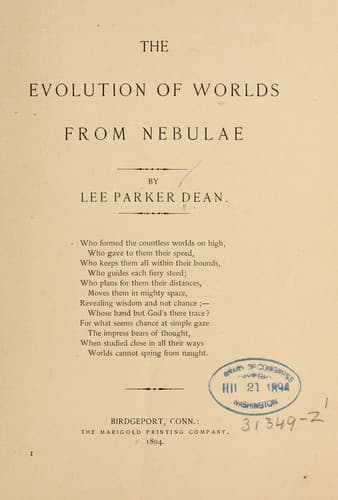
The evolution of worlds from nebulaeDean, Lee Parker
Science
The evolution of worlds from nebulae
Dean, Lee Parker
Nebular hypothesis
When we realize that without the sun’s heat and light we ourselves
could not here exist; that it has power to lift the waters that are
unfit for man’s use and restore them again in a purified state; and
power to produce food for him both in the animal and vegetable kingdom,
the truth is not lessened. Were the sun nearer the earth or farther
away all life would here be destroyed; and should any one of all the
suns in space vary the least in its orbit it would be the destruction
of earth. Yet as far as we have learned no sun has ever come within
twenty trillions of miles to interfere with our globe, and from all the
above facts we may well believe there are truths concerning the sun’s
light and heat that we do not yet understand.
That the ocean keeps up its supply of radiation, and as far as we see
never diminishes; that the heat from volcanoes and all other fires
of earth does not escape from earth’s hold, but is returned in new
forms to be used again; leads us to question whether earth’s heat
passes beyond its own atmosphere. The heat of our great solar light
may likewise be equal to that of Adam’s day and continue thus unwasted
until the end of time, or until its great Author sees fit to change it.
While astronomers tell us that the diminution of the sun’s diameter
1/10,000 part would liberate heat enough to supply its current
expenditure for about 2,000 years, they have also shown that it could
be supplied by the friction meteors would cause by rushing into the
sun; provided that the number falling into it in one year equalled the
moon’s volume.[18] We can know little of the number there may be, for
only that they occasionally fall into our atmosphere and are instantly
burned, we should not know of their existence. But it is said that
every 33 years we pass through a shoal of them 100,000 miles broad,
and many thousand times greater in length, and that it has been thus
for centuries. Prof. Newton estimates the average number of meteors
that traverse our atmosphere daily, large enough to be visible to the
eye on a dark night, is 7,500,000. With the telescope-meteors added,
the number is increased to 400 millions. As the sun is more than a
million times the size of the earth should the number falling into it
be increased at the same rate it might reach 150 quadrillions daily,
170,000 falling on every square mile of the sun’s surface.
Public-domain text, read in full here on John Shaqi.
Reviews
Reviews
No reviews yet
Be the first to share your thoughts on this work.
Join the Discussion
Join the discussion
Sign in to leave a comment or review.
Sign InorCreate an account