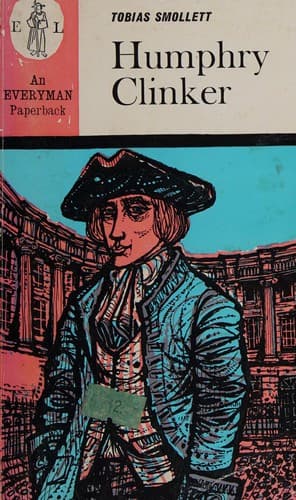
The Expedition of Humphry ClinkerSmollett, T. (Tobias)
General
The Expedition of Humphry Clinker
Smollett, T. (Tobias)
Epistolary fiction; Great Britain -- Fiction; Travelers -- Fiction
The captain answered, that this supposition must have been deduced
either from their conversation or their compositions, of which the
English could not possibly judge with precision, as they did not
understand the dialect used by the Scots in common discourse, as well
as in their works of humour. When I desired to know what those works
of humour were, he mentioned a considerable number of pieces, which
he insisted were equal in point of humour to any thing extant in any
language dead or living--He, in particular, recommended a collection of
detached poems, in two small volumes, intituled, The Ever-Green, and
the works of Allan Ramsay, which I intend to provide myself with at
Edinburgh.--He observed, that a North-Briton is seen to a disadvantage
in an English company, because he speaks in a dialect that they can’t
relish, and in a phraseology which they don’t understand.--He therefore
finds himself under a restraint, which is a great enemy to wit and
humour.--These are faculties which never appear in full lustre, but when
the mind is perfectly at ease, and, as an excellent writer says, enjoys
her elbow-room.
He proceeded to explain his assertion that the English language was
spoken with greater propriety at Edinburgh than in London. He said, what
we generally called the Scottish dialect was, in fact, true, genuine old
English, with a mixture of some French terms and idioms, adopted in a
long intercourse betwixt the French and Scotch nations; that the modern
English, from affectation and false refinement, had weakened, and even
corrupted their language, by throwing out the guttural sounds, altering
the pronunciation and the quantity, and disusing many words and terms
of great significance. In consequence of these innovations, the works
of our best poets, such as Chaucer, Spenser, and even Shakespeare, were
become, in many parts, unintelligible to the natives of South Britain,
whereas the Scots, who retain the antient language, understand them
without the help of a glossary. ‘For instance (said he), how have
your commentators been puzzled by the following expression in the
Tempest--He’s gentle and not fearful: as if it was a paralogism to say,
that being gentle, he must of course be courageous: but the truth is,
one of the original meanings, if not the sole meaning, of that word was,
noble, high-minded; and to this day, a Scotch woman, in the situation of
the young lady in the Tempest, would express herself nearly in the same
terms--Don’t provoke him; for being gentle, that is, high-spirited, he
won’t tamely bear an insult. Spenser, in the very first stanza of his
Fairy Queen, says,
A gentle knight was pricking on the plain;
Which knight, far from being tame and fearful, was so stout that
Nothing did he dread, but ever was ydrad.
Public-domain text, read in full here on John Shaqi.
Reviews
Reviews
No reviews yet
Be the first to share your thoughts on this work.
Elsewhere in the archive
Join the Discussion
Join the discussion
Sign in to leave a comment or review.
Sign InorCreate an account