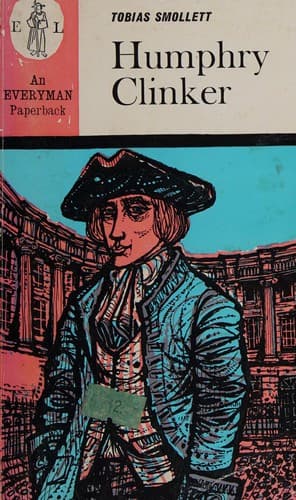
The Expedition of Humphry ClinkerSmollett, T. (Tobias)
General
The Expedition of Humphry Clinker
Smollett, T. (Tobias)
Epistolary fiction; Great Britain -- Fiction; Travelers -- Fiction
To prove that we had impaired the energy of our language by false
refinement, he mentioned the following words, which, though widely
different in signification, are pronounced exactly in the same manner
wright, write, right, rite; but among the Scots, these words are as
different in pronunciation, as they are in meaning and orthography;
and this is the case with many others which he mentioned by way of
illustration.--He, moreover, took notice, that we had (for what reason
he could never learn) altered the sound of our vowels from that which is
retained by all the nations in Europe; an alteration which rendered
the language extremely difficult to foreigners, and made it
almost impracticable to lay down general rules for orthography and
pronunciation. Besides, the vowels were no longer simple sounds in
the mouth of an Englishman, who pronounced both i and u as dipthongs.
Finally, he affirmed, that we mumbled our speech with our lips and
teeth, and ran the words together without pause or distinction, in such
a manner, that a foreigner, though he understood English tolerably well,
was often obliged to have recourse to a Scotchman to explain what a
native of England had said in his own language.
The truth of this remark was confirmed by Mr Bramble from his own
experience; but he accounted for it on another principle. He said,
the same observation would hold in all languages; that a Swiss talking
French was more easily understood than a Parisian, by a foreigner who
had not made himself master of the language; because every language
had its peculiar recitative, and it would always require more pains,
attention, and practice, to acquire both the words and the music, than
to learn the words only; and yet no body would deny, that the one
was imperfect without the other: he therefore apprehended, that the
Scotchman and the Swiss were better understood by learners, because they
spoke the words only, without the music, which they could not rehearse.
One would imagine this check might have damped the North Briton; but it
served only to agitate his humour for disputation.--He said, if every
nation had its own recitative or music, the Scots had theirs, and the
Scotchman who had not yet acquired the cadence of the English, would
naturally use his own in speaking their language; therefore, if he
was better understood than the native, his recitative must be more
intelligible than that of the English; of consequence, the dialect of
the Scots had an advantage over that of their fellow-subjects, and this
was another strong presumption that the modern English had corrupted
their language in the article of pronunciation.
Public-domain text, read in full here on John Shaqi.
Reviews
Reviews
No reviews yet
Be the first to share your thoughts on this work.
Elsewhere in the archive
Join the Discussion
Join the discussion
Sign in to leave a comment or review.
Sign InorCreate an account