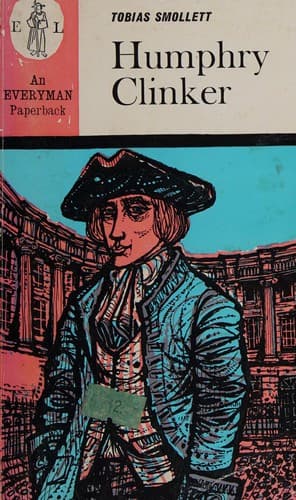
The Expedition of Humphry ClinkerSmollett, T. (Tobias)
General
The Expedition of Humphry Clinker
Smollett, T. (Tobias)
Epistolary fiction; Great Britain -- Fiction; Travelers -- Fiction
But the most hardy of all this original’s positions were these: That
commerce would, sooner or later, prove the ruin of every nation, where
it flourishes to any extent--that the parliament was the rotten part of
the British constitution--that the liberty of the press was a national
evil--and that the boasted institution of juries, as managed in England,
was productive of shameful perjury and flagrant injustice. He observed,
that traffick was an enemy to all the liberal passions of the soul,
founded on the thirst of lucre, a sordid disposition to take advantage
of the necessities of our fellow creatures.--He affirmed, the nature
of commerce was such, that it could not be fixed or perpetuated, but,
having flowed to a certain height, would immediately begin to ebb, and
so continue till the channels should be left almost dry; but there
was no instance of the tide’s rising a second time to any considerable
influx in the same nation. Mean while the sudden affluence occasioned
by trade, forced open all the sluices of luxury and overflowed the land
with every species of profligacy and corruption; a total pravity of
manners would ensue, and this must be attended with bankruptcy and ruin.
He observed of the parliament, that the practice of buying boroughs,
and canvassing for votes, was an avowed system of venality, already
established on the ruins of principle, integrity, faith, and good order,
in consequence of which the elected and the elector, and, in short, the
whole body of the people, were equally and universally contaminated and
corrupted. He affirmed, that of a parliament thus constituted, the crown
would always have influence enough to secure a great majority in its
dependence, from the great number of posts, places, and pensions it
had to bestow; that such a parliament would (as it had already done)
lengthen the term of its sitting and authority, whenever the prince
should think it for his interest to continue the representatives, for,
without doubt, they had the same right to protect their authority ad
infinitum, as they had to extend it from three to seven years.--With a
parliament, therefore, dependent upon the crown, devoted to the prince,
and supported by a standing army, garbled and modelled for the purpose,
any king of England may, and probably some ambitious sovereign will,
totally overthrow all the bulwarks of the constitution; for it is not
to be supposed that a prince of high spirit will tamely submit to be
thwarted in all his measures, abused and insulted by a populace of
unbridled ferocity, when he has it in his power to crush all opposition
under his feet with the concurrence of the legislature. He said, he
should always consider the liberty of the press as a national evil,
while it enabled the vilest reptile to soil the lustre of the most
shining merit, and furnished the most infamous incendiary with the means
of disturbing the peace and destroying the good order of the community.
Public-domain text, read in full here on John Shaqi.
Reviews
Reviews
No reviews yet
Be the first to share your thoughts on this work.
Elsewhere in the archive
Join the Discussion
Join the discussion
Sign in to leave a comment or review.
Sign InorCreate an account