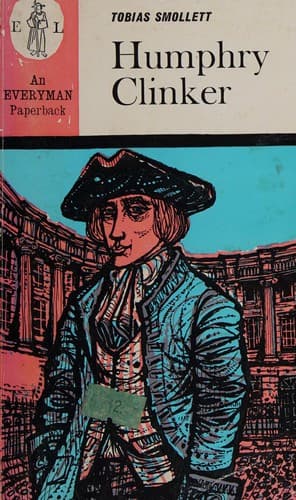
The Expedition of Humphry ClinkerSmollett, T. (Tobias)
General
The Expedition of Humphry Clinker
Smollett, T. (Tobias)
Epistolary fiction; Great Britain -- Fiction; Travelers -- Fiction
unload their ships at Greenock and Port-Glasgow, situated about fourteen
miles nearer the mouth of the Frith, where it is about two miles broad.
The people of Glasgow have a noble spirit of enterprise--Mr Moore, a
surgeon, to whom I was recommended from Edinburgh, introduced me to all
the principal merchants of the place. Here I became acquainted with
Mr Cochran, who may be stiled one of the sages of this kingdom. He was
first magistrate at the time of the last rebellion. I sat as member
when he was examined in the house of commons, upon which occasion Mr P--
observed he had never heard such a sensible evidence given at that bar.
I was also introduced to Dr John Gordon, a patriot of a truly Roman
spirit, who is the father of the linen manufacture in this place, and
was the great promoter of the city workhouse, infirmary, and other works
of public utility. Had he lived in ancient Rome, he would have been
honoured with a statue at the public expence. I moreover conversed with
one Mr G--ssf--d, whom I take to be one of the greatest merchants in
Europe. In the last war, he is said to have had at one time five and
twenty ships with their cargoes, his own property, and to have traded
for above half a million sterling a-year. The last war was a fortunate
period for the commerce of Glasgow--The merchants, considering that
their ships bound for America, launching out at once into the Atlantic
by the north of Ireland, pursued a track very little frequented
by privateers, resolved to insure one another, and saved a very
considerable sum by this resolution, as few or none of their ships were
taken--You must know I have a sort of national attachment to this part
of Scotland--The great church dedicated to St Mongah, the river Clyde,
and other particulars that smack of our Welch language and customs,
contribute to flatter me with the notion, that these people are the
descendants of the Britons, who once possessed this country. Without
all question, this was a Cumbrian kingdom: its capital was Dumbarton (a
corruption of Dunbritton) which still exists as a royal borough, at
the influx of the Clyde and Leven, ten miles below Glasgow. The same
neighbourhood gave birth to St Patrick, the apostle of Ireland, at a
place where there is still a church and village, which retain his name.
Hard by are some vestiges of the famous Roman wall, built in the reign
of Antonine, from the Clyde to the Forth, and fortified with castles, to
restrain the incursions of the Scots or Caledonians, who inhabited
the West-Highlands. In a line parallel to this wall, the merchants of
Glasgow have determined to make a navigable canal betwixt the two Firths
which will be of incredible advantage to their commerce, in transporting
merchandize from one side of the island to the other.
Public-domain text, read in full here on John Shaqi.
Reviews
Reviews
No reviews yet
Be the first to share your thoughts on this work.
Elsewhere in the archive
Join the Discussion
Join the discussion
Sign in to leave a comment or review.
Sign InorCreate an account