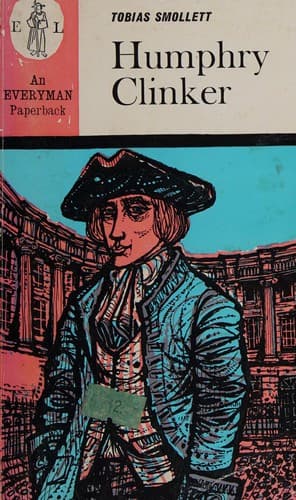
The Expedition of Humphry ClinkerSmollett, T. (Tobias)
General
The Expedition of Humphry Clinker
Smollett, T. (Tobias)
Epistolary fiction; Great Britain -- Fiction; Travelers -- Fiction
From Glasgow we travelled along the Clyde, which is a delightful stream,
adorned on both sides with villas, towns, and villages. Here is no want
of groves, and meadows, and corn-fields interspersed; but on this side
of Glasgow, there is little other grain than oats and barley; the first
are much better, the last much worse, than those of the same species in
England. I wonder, there is so little rye, which is a grain that will
thrive in almost any soil; and it is still more surprising, that the
cultivation of potatoes should be so much neglected in the Highlands,
where the poor people have not meal enough to supply them with bread
through the winter. On the other side of the river are the towns of
Paisley and Renfrew. The first, from an inconsiderable village, is
become one of the most flourishing places of the kingdom, enriched
by the linen, cambrick, flowered lawn, and silk manufactures. It was
formerly noted for a rich monastery of the monks of Clugny, who wrote
the famous Scoti-Chronicon, called The Black Book of Paisley. The old
abbey still remains, converted into a dwelling-house, belonging to the
earl of Dundonald. Renfrew is a pretty town, on the banks of Clyde,
capital of the shire, which was heretofore the patrimony of the Stuart
family, and gave the title of baron to the king’s eldest son, which is
still assumed by the prince of Wales.
The Clyde we left a little on our left-hand at Dunbritton, where it
widens into an aestuary or frith, being augmented by the influx of the
Leven. On this spot stands the castle formerly called Alcluyd, washed,
by these two rivers on all sides, except a narrow isthmus, which at
every spring-tide is overflowed. The whole is a great curiosity, from
the quality and form of the rock, as well as from the nature of its
situation--We now crossed the water of Leven, which, though nothing near
so considerable as the Clyde, is much more transparent, pastoral, and
delightful. This charming stream is the outlet of Lough-Lomond, and
through a tract of four miles pursues its winding course, murmuring over
a bed of pebbles, till it joins the Frith at Dunbritton. A very little
above its source, on the lake, stands the house of Cameron, belonging to
Mr Smollett, so embosomed in an oak wood, that we did not see it till
we were within fifty yards of the door. I have seen the Lago di Garda,
Albano, De Vico, Bolsena, and Geneva, and, upon my honour, I prefer
Lough-Lomond to them all, a preference which is certainly owing to the
verdant islands that seem to float upon its surface, affording the most
inchanting objects of repose to the excursive view. Nor are the banks
destitute of beauties, which even partake of the sublime. On this side
they display a sweet variety of woodland, cornfield, and pasture, with
several agreeable villas emerging as it were out of the lake, till, at
some distance, the prospect terminates in huge mountains covered with
heath, which being in the bloom, affords a very rich covering of purple.
Public-domain text, read in full here on John Shaqi.
Reviews
Reviews
No reviews yet
Be the first to share your thoughts on this work.
Elsewhere in the archive
Join the Discussion
Join the discussion
Sign in to leave a comment or review.
Sign InorCreate an account