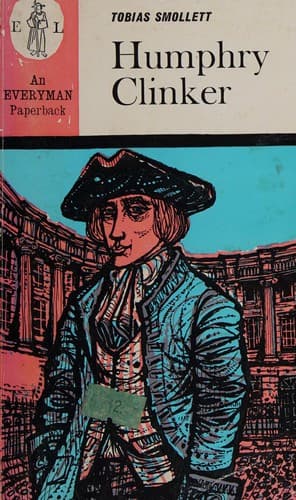
The Expedition of Humphry ClinkerSmollett, T. (Tobias)
General
The Expedition of Humphry Clinker
Smollett, T. (Tobias)
Epistolary fiction; Great Britain -- Fiction; Travelers -- Fiction
room; but before he quitted the parlour, he intreated the good company
to assist him with their prayers.--He added, ‘Take warning by me, who
am suddenly cut off in my prime, like a flower of the field; and God
forgive you, Sir Thomas, for suffering such poisonous trash to be eaten
at your table.’
He was no sooner removed out of hearing, than the baronet abandoned
himself to a violent fit of laughing, in which he was joined by the
greatest part of the company; but we could hardly prevent the good lady
from going to undeceive the patient, by discovering, that while he slept
his waistcoat had been straitened by the contrivance of the surgeon;
and that the disorder in his stomach and bowels was occasioned by some
antimonial wine, which he had taken over night, under the denomination
of plague-water. She seemed to think that his apprehension might put an
end to his life: the knight swore he was no such chicken, but a
tough old rogue, that would live long enough to plague all his
neighbours.--Upon enquiry, we found his character did not intitle him to
much compassion or respect, and therefore we let our landlord’s humour
take its course.--A glyster was actually administered by an old woman
of the family, who had been Sir Thomas’s nurse, and the patient took
a draught made with oxymel of squills to forward the operation of the
antimonial wine, which had been retarded by the opiate of the preceding
night. He was visited by the vicar, who read prayers, and began to take
an account of the state of his soul, when those medicines produced their
effect; so that the parson was obliged to hold his nose while he poured
forth spiritual consolation from his mouth. The same expedient was used
by the knight and me, who, with the doctor, entered the chamber at this
juncture, and found Frogmore enthroned on an easing-chair, under the
pressure of a double evacuation. The short intervals betwixt every heave
he employed in crying for mercy, confessing his sins, or asking the
vicar’s opinion of his case; and the vicar answered, in a solemn
snuffling tone, that heightened the ridicule of the scene. The emetic
having done its office, the doctor interfered, and ordered the patient
to be put in bed again. When he examined the egesta, and felt his pulse,
he declared that much of the virus was discharged, and, giving him a
composing draught, assured him he had good hopes of his recovery.--This
welcome hint he received with the tears of joy in his eyes, protesting,
that if he should recover, he would always think himself indebted for
his life to the great skill and tenderness of his doctor, whose hand he
squeezed with great fervour; and thus he was left to his repose.
Public-domain text, read in full here on John Shaqi.
Reviews
Reviews
No reviews yet
Be the first to share your thoughts on this work.
Elsewhere in the archive
Join the Discussion
Join the discussion
Sign in to leave a comment or review.
Sign InorCreate an account