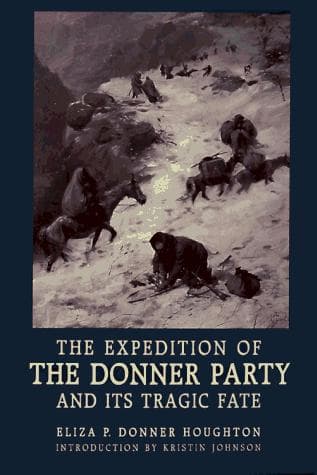
The Expedition of the Donner Party and its Tragic FateHoughton, Eliza Poor Donner
History
The Expedition of the Donner Party and its Tragic Fate
Houghton, Eliza Poor Donner
Donner Party; Overland journeys to the Pacific
On those evenings when grandma visited the sick, or went from home on
errands, we children were tucked away early in our trundle bed. There,
and by ourselves, we spoke of mother and the mountains. Not
infrequently, however, our thoughts would be recalled to the present by
loud, wailing squeak-squawk, squeak-squawks. As the sound drew nearer
and became shriller, we would put our fingers in our ears to muffle the
dismal tones, which we knew were only the creakings of the two wooden
wheels of some Mexican _carreta_, laboriously bringing passengers to
town, or perhaps a cruder one carrying hides to the _embarcadero_, or
possibly supplies to adjacent _ranchos_. We wondered how old people and
mothers with sick children could travel in such uncomfortable vehicles
and not become distracted by their nerve-piercing noises. Then, like a
bird-song, pleasanter scenes would steal in upon our musings, of gay
horseback parties on their way to church feasts, or fandangos, preceded
or followed by servants in charge of pack animals laden with luggage.
We rarely stayed awake long enough to say all we wished about the
Spanish people. Their methods of travel, modes of dress, and
fascinating manners were sources of never-ending discussion and
interest.
[Illustration: OLD MEXICAN CARRETA]
[Illustration: RESIDENCE OF JUDGE A.L. RHODES, A TYPICAL CALIFORNIA
HOUSE OF THE BETTER CLASS IN 1849]
We had seen princely dons of many leagues ride by in state; dashing
_caballeros_ resplendent in costumes of satin and velvet, on their way
to sing beneath the windows of dark-eyed _señoritas;_ and had stood
close enough to the wearers of embroidered and lace-bedecked small
clothes, to count the scallops which closed the seams of their outer
garments, and to hear the faint tinkle of the tiny silver bells which
dangled from them. We had feasted our eyes on magnificently robed
_señoras_ and _señoritas_; caught the scent of the roses twined in
their hair, and the flash of jewels on their persons.
Such frequent object-lessons made the names and surroundings of those
grandees easy to remember. Some lived leagues distant, some were near
neighbors in that typical Mexican Pueblo of Sonoma, whose adobe walls
and red-tiled roofs nestled close to the foot of the dimpled hills
overlooking the valley from the north, and whose historic and romantic
associations were connected with distinguished families who still
called it home.
Foremost among the men was General Mariano Guadalupe Vallejo, by whom
Sonoma was founded in 1834, upon ground which had twice been
consecrated to Mission use. First by Padre Altemera, who had, in 1823,
established there the church and mission building of San Francisco
Solano. And four years later, after hostile Indians had destroyed the
sacred structures, Padre Fortune, under protection of Presidio Golden
Gate, blessed the ashes and rebuilt the church and the parochial
houses named last on the list of the historic Missions of California.
Public-domain text, read in full here on John Shaqi.
Reviews
Reviews
No reviews yet
Be the first to share your thoughts on this work.
Elsewhere in the archive
Join the Discussion
Join the discussion
Sign in to leave a comment or review.
Sign InorCreate an account