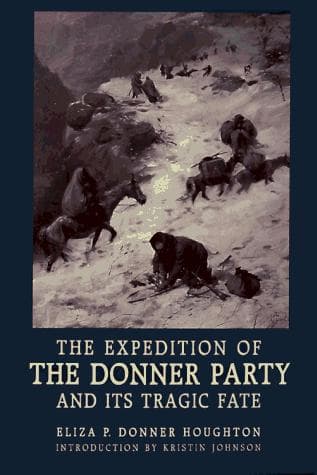
The Expedition of the Donner Party and its Tragic FateHoughton, Eliza Poor Donner
History
The Expedition of the Donner Party and its Tragic Fate
Houghton, Eliza Poor Donner
Donner Party; Overland journeys to the Pacific
The Vallejo home covered the largest plot of ground on the north side
of the plaza, and its great house had a hospitable air, despite its
lofty watchtower, begrimed by sentry holes, overlooking every part of
the valley.
During the period that its owner was _commandante_ of the northern
frontier, the Vallejo home was headquarters for high officials of the
province. But after Commodore Sloat raised the Stars and Stripes at
Monterey, General Vallejo espoused the cause of the United States, put
aside much of his Spanish exclusiveness, and opened his doors to
Americans as graciously as to friends of his own nationality.
A historic souvenir greatly prized by Americans in town and valley was
the flag pole, which in Sonoma's infancy had been hewn from the distant
mountain forest, and brought down on pack animals by mission Indians
under General Vallejo's direction. It originally stood in the centre of
the plaza, where it was planted with sacred ceremonials, and where amid
ringing cheers of "_Viva Mexico!_" it first flung to the breeze that
country's symbolical banner of green, white, and red. Through ten
fitful years it loyally waved those colors; then followed its brief
humiliation by the Bear Flag episode, and early redemption by order of
Commodore Sloat, who sent thither an American flag-bearer to invest it
with the Stars and Stripes. Thereafter, a patriotic impulse suggested
its removal to the parade ground of the United States Army post, and
as Spanish residents looked upon it as a thornful reminder of lost
power they felt no regret when Uncle Sam's boys transplanted it to new
environments and made it an American feature by adoption.
But the Mexican landmark which appealed to me most pathetically was the
quaint rustic belfry which stood solitary in the open space in front of
the Mission buildings. Its strong columns were the trunks of trees that
looked as though they might have grown there for the purpose of
shouldering the heavy cross-beams from which the chimes hung. Its
smooth timbers had been laboriously hewn by hand, as must be the case
in a land where there are no saw mills. The parts that were not bound
together with thongs of rawhide, were held in place by wooden pegs. The
strips of rawhide attached to the clappers dropped low enough for me to
reach, and often tempted me to make the bells speak.
Mission padres no longer dwelt in the buildings, but shepherds from
distant folds came monthly to administer to the needs of this
consecrated flock. Then the many bells would call the faithful to mass,
and to vespers, or chime for the wedding of favored sons and daughters.
Part of them would jingle merrily for notable christenings; but one
only would toll when death whitened the lips of some distinguished
victim; and again, while the blessed body was being borne to its last
resting-place.
Public-domain text, read in full here on John Shaqi.
Reviews
Reviews
No reviews yet
Be the first to share your thoughts on this work.
Elsewhere in the archive
Join the Discussion
Join the discussion
Sign in to leave a comment or review.
Sign InorCreate an account