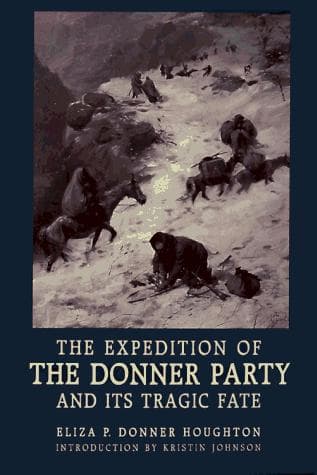
The Expedition of the Donner Party and its Tragic FateHoughton, Eliza Poor Donner
History
The Expedition of the Donner Party and its Tragic Fate
Houghton, Eliza Poor Donner
Donner Party; Overland journeys to the Pacific
FEVER PATIENTS FROM THE MINES--UNMARKED GRAVES--THE TALES AND TAUNTS
THAT WOUNDED MY YOUNG HEART.
A short experience in the mines cured grandpa's "mining fever," but
increased his rheumatism. The accounts he brought of sufferings he had
witnessed in the camps prepared us for the approaching autumn's work,
when many of the happy fellows who had started to the gold-fields in
vigorous health and with great expectations returned haggard, sick, and
out of luck.
Then was noble work done by the pioneer women. No door was closed
against the needy. However small the house might be, its inmates had
some comfort to offer the stranger. Many came to grandma, saying they
had places to sleep but begging that she would give them food and
medicine until they should be able to proceed to San Francisco.
Weary mortals dragged their aching limbs to the benches under her white
oak tree, dropped upon them, with blankets still across their
shoulders, declaring they could not go another rod. Often, she turned
her face aside and murmured, "God help the poor wanderers"; but to them
she would say encouragingly, "You be not very sick, you will soon be
rested. There be straw in the stack that we will bring for your bed,
and me and the children will let you not go hungry."
Ere long, beds had to be made on the floor of the unfinished house.
More were needed, and they were spread under the great white oak.
On a block beside each fever patient stood a tin cup, which Georgia and
I were charged to keep full of cold water, and it was pitiful to see
the eyes of the sick watch the cooling stream we poured. Our patients
eagerly grasped the cup with unsteady hands, so that part of its
contents did not reach the parched lips. Often, we heard the fervid
prayer, "God bless the women of this land, and bless the children too!"
Soon we learned to detect signs of improvement, and were rejoiced when
the convalescents smiled and asked for more to eat. Grandma carried
most of the food to them and sent us later for the empty dishes.
Of the many who came to us that season, there was but one who never
proceeded on his way. He was a young German, fair of face, but terribly
wasted by disease. His gentle, boyish manner at once made him a
favorite, and we not only gave him our best care, but when a physician
drifted into town, grandma sent for him and followed his directions. I
remember well the day that John seemed almost convalescent, relished
his breakfast, wanted to talk a while, and before we left him, had us
bring him a basin of warm water and his beflowered carpet bag, from
which he took a change of clothing and his shaving outfit.
Public-domain text, read in full here on John Shaqi.
Reviews
Reviews
No reviews yet
Be the first to share your thoughts on this work.
Elsewhere in the archive
Join the Discussion
Join the discussion
Sign in to leave a comment or review.
Sign InorCreate an account