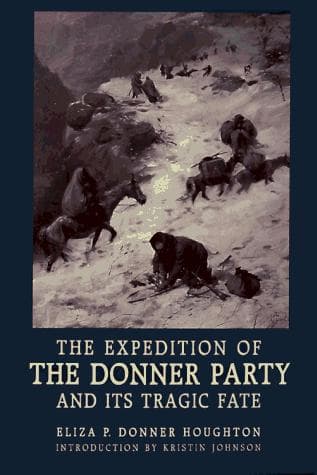
The Expedition of the Donner Party and its Tragic FateHoughton, Eliza Poor Donner
History
The Expedition of the Donner Party and its Tragic Fate
Houghton, Eliza Poor Donner
Donner Party; Overland journeys to the Pacific
When we saw him later, his hair was smoothly combed; he looked neat and
felt encouraged, and was sure that he should soon be up and doing for
himself. At nightfall, grandma bade us wipe the dishes quickly as
possible, at which Georgia proposed a race to see whether she could
wash fast enough to keep us busy, and we got into a frolicsome mood,
which grandma put an end to with the sobering remark:
"Oh, be not so worldly-minded. John ist very bad to-night. I be in a
hurry to go back to him, and you must hold the candle."
We passed out into the clear cold starlight, with the burning candle
sheltered by a milk pan, and picked our way between the lumber to the
unfinished room where John lay. I was the last to enter, and saw
grandma hurriedly give the candle to Georgia, drop upon her knees
beside the bed, touch his forehead, lift his hand, and call him by
name. The damp of death was on his brow, the organs of speech had lost
their power. One long upward look, a slight quivering of the muscles of
the face, and we were alone with the dead. I was so awed that I could
scarcely move, but grandma wept over him, as she prepared his body for
burial.
The next afternoon, we three and grandpa and a few friends followed him
to his final resting-place. After he was gone, grandma remembered that
she did not know his name in full, the land of his birth, nor the
address of his people. Expecting his recovery, she had not troubled him
with questions, and the few trinkets in his carpet bag yielded no
identifying clue. So he lies in a nameless grave, like countless other
youth of that period.
We had patients of every type, those who were appreciative and
grateful, and those who rebelled against confinement, and swore at the
pain which kept sleep from their eyes, and hurled their things about
regardless of consequences. The most trying were the chronic grumblers,
who did not know what they wanted, nor what they ought to have, and
adopted the moody refrain:
But the happy times are over,
I've only grief and pain,
For I shall never, never see
Susannah dear again.
The entrance of Georgia and myself would occasionally turn their
thoughts into homeward channels, and make them reminiscent of their
little children and loved ones "back in the States." Then, again, our
coming would set them to talking about our early disaster and such
horrible recounts of happenings in the snow-bound camps that we would
rush away, and poor Georgia would have distressing crying spells over
what we had heard.
At first no tears dimmed my eyes, for I felt, with keen indignation,
that those wounding tales were false; but there came hours of suffering
for me later, when an unsympathetic soldier, nicknamed "Picayune
Butler," engaged me in conversation and set me to thinking.
Public-domain text, read in full here on John Shaqi.
Reviews
Reviews
No reviews yet
Be the first to share your thoughts on this work.
Elsewhere in the archive
Join the Discussion
Join the discussion
Sign in to leave a comment or review.
Sign InorCreate an account