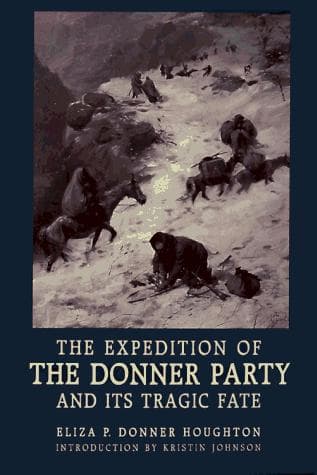
The Expedition of the Donner Party and its Tragic FateHoughton, Eliza Poor Donner
History
The Expedition of the Donner Party and its Tragic Fate
Houghton, Eliza Poor Donner
Donner Party; Overland journeys to the Pacific
After another long day's drive, we stopped on a mountain-side close to
a spring of cold, sweet water. While supper was being prepared, one of
the fires crept beyond bounds, spread rapidly, and threatened
destruction to part of our train. At the critical moment two strange
Indians rushed upon the scene and rendered good service. After the fire
was extinguished, the Indians were rewarded, and were also given a
generous meal at the tent of Mr. Graves. Later, they settled themselves
in friendly fashion beside his fire and were soon fast asleep. Next
morning, the Indians were gone, and had taken with them a new shirt and
a yoke of good oxen belonging to their host.
Within the week, Indians again sneaked up to camp, and stole one of Mr.
Graves's saddle-horses. These were trials which made men swear
vengeance, yet no one felt that it would be safe to follow the
marauders. Who could know that the train was not being stealthily
followed by cunning plunderers who would await their chance to get away
with the wagons, if left weakly guarded?
Conditions now were such that it seemed best to divide the train into
sections and put each section under a sub-leader. Our men were well
equipped with side arms, rifles, and ammunition; nevertheless, anxious
moments were common, as the wagons moved slowly and singly through
dense thickets, narrow defiles, and rugged mountain gorges, one section
often being out of sight of the others, and each man realizing that
there could be no concerted action in the event of a general attack;
that each must stay by his own wagon and defend as best he could the
lives committed to his care. No one rode horseback now, except the
leaders, and those in charge of the loose cattle. When darkness
obscured the way, and after feeding-time, each section formed its
wagons into a circle to serve as cattle corral, and night watches were
keenly alert to give a still alarm if anything unusual came within
sight or sound.
Day after day, from dawn to twilight, we moved onward, never stopping,
except to give the oxen the necessary nooning, or to give them drink
when water was available. Gradually, the distance between sections
lengthened, and so it happened that the wagons of my father and my
uncle were two days in advance of the others, on the eighth of October,
when Mr. Reed, on horseback, overtook us. He was haggard and in great
tribulation. His lips quivered as he gave substantially the following
account of circumstances which had made him the slayer of his friend,
and a lone wanderer in the wilderness.
Public-domain text, read in full here on John Shaqi.
Reviews
Reviews
No reviews yet
Be the first to share your thoughts on this work.
Join the Discussion
Join the discussion
Sign in to leave a comment or review.
Sign InorCreate an account